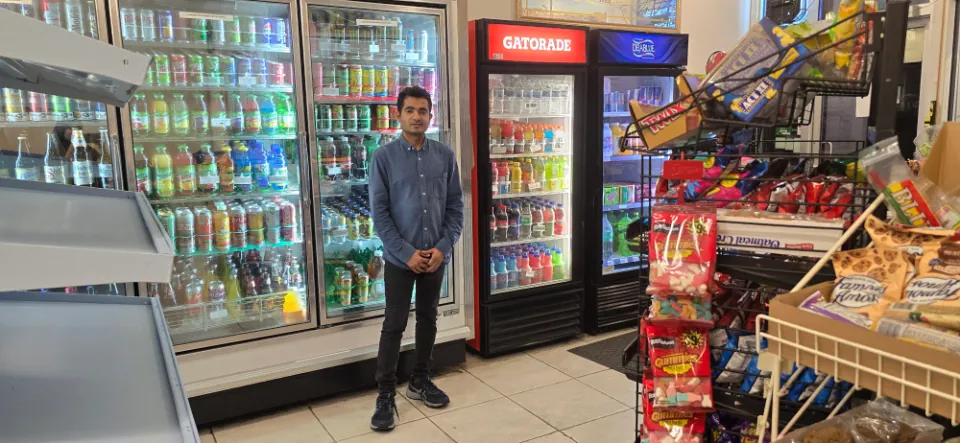
My name is Mohammed and I left my homeland Burma alone at the age of 13 in 2007 to flee persecution, discrimination and violence. I arrived in the United States in 2023 with my wife and two boys and moved to Wisconsin to join my brother. From an early age I learned the value of being a business owner and being able to create an income for myself. I have a passion for continued learning, business and farming. I am excited to have bought a mini mart business near my home, a start of so many dreams I wish to fulfill here in the United States.
My earliest memories are filled with a love of learning. I began school at the age of 4 learning Burmese, Arabic and English. Today I can speak 10 different languages. I was forced to grow up fast at age 7 when my world fell apart. My mother was killed while in the hospital delivering my youngest sister in a hate crime because she was Muslim. I was so sad and I was unable to concentrate in school and thus my formal education was put on pause during that time. As the oldest of 6 siblings in my household, I also felt a great responsibility and under the advice of my grandma I “learned how to make money.” By the of age 10 with no child labor laws in Burma, I was running a fishing net contracting business employing dozens of people and providing for my family.
At age 13, I decided to flee Burma for a better life in Malaysia. Due to my age, I was unable to leave legally but with my business profits, I paid my way to join a group of 110 others on a rowboat destined for Malaysia. The journey was filled with anguish, death, fear, abuse and many detours but after 4 months I finally arrived penniless. I found work as a laborer and within 6 months, I had learned the language, bought a phone and a bus ticket to join a cousin in Kuala Lumpur. It was there that I began to pursue my education again and work to gain refugee status through the United Nations.
During that time, I worked for the Embassy of Pakistan during the day and I continued my education at night. I was able to provide for myself, send money home to my family and save to invest in my own businesses. I eventually enrolled at Help International University, married and moved on to become an interpreter with the United Nations. Throughout my life in Malaysia, I also owned and operated multiple businesses including a bakery, a grocery and a farm.
We are excited to build a life in the United States and raise our growing family (we just found out we have another baby on the way). We thank you in advance for your trust and support to build our business.
 Adding to basket
Funded
Mohammad
Rashid Mini Mart

Repayment schedule
Monthly: One repayment made per month
End of term: One repayment made at the end of the loan term
Irregular: Any other repayment schedule
To see a detailed repayment schedule for a specific loan, click the "Repayment schedule" link on the loan profile under "Loan details."
What is the disbursed date?
In the case of partner loans, many of our Lending Partners choose to disburse loan funds before the loan request is posted on Kiva. We allow pre-disbursal because it ensures that the funds reach the borrower as soon as they are needed. Loan funds from Kiva lenders then go to backfill that amount and as a lender you assume the risk of the loan. By doing this, our Lending Partners assume the risk that, if the loan isn't funded by lenders, they will have to fund the loan without any funds from Kiva.
If a partner loan is not pre-disbursed, it will be listed on Kiva with an expected "post-disbursed" date. If a post-disbursed loan is not funded on Kiva, there is a chance that the borrower may not receive their loan. Some Lending Partners choose to disburse loans with other sources of funding, while other partners don't have the resources available to fund loans without Kiva lenders' support. No direct loans will be disbursed unless they fully fundraise on Kiva.
Funding model
What does "Partner covers currency loss" mean & how could it affect my Kiva loans?
Potential for currency exchange loss is noted on every loan profile under the loan details:
"Yes" means the Lending Partner will cover any currency loss. Lenders will not bear losses due to currency fluctuation
"Partial" means that the Lending Partner has opted to cover losses only up to 10%. If the U.S. dollar appreciates more than 10% against the local currency, those losses will be passed onto lenders.
"No" means that the Lending Partner is not covering any currency losses and all losses will be passed onto lenders.
"N/A" means the Lending Partner disburses loans to borrowers in USD so their loans are not subject to any currency fluctuation.
Do Kiva borrowers pay any interest on their loans?
Our partners collect interest from borrowers because there are many operational expenses associated with microfinance in developing markets, especially in rural areas. Many of Kiva's Lending Partners also provide additional services alongside their loan products such as business training, financial literacy lessons, or health services.
Kiva will not partner with an organization that charges unreasonable interest rates, and we require Lending Partners to fully disclose their rates. In addition, we only partner with microfinance institutions and organizations that have a social mission to serve the poor, unbanked, and underserved.
There are some 0% interest loans on Kiva, including all direct loans in the United States. To learn more about the interest rates Kiva borrowers pay, you can review the "Average cost to borrower" field on a loan profile.
We also encourage you to read the following articles if you are interested in further educating yourself on the topic: Microfinance 101 (https://www.kiva.org/microfinance), Top 10 things to know about microfinance (https://www.kiva.org/blog/top-10-things-to-know-about-microfinance), Microfinance interest rates explained (https://www.kiva.org/blog/whats-up-with-microfinance-interest-rates)
What is a risk rating?
The Lending Partner risk rating reflects the risk of institutional default associated with each of Kiva’s Lending Partners. A 0.5-star rating means the organization has a relatively higher risk of institutional default, while a 5-star rating indicates the organization is at a relatively lower risk of default, based on Kiva's analysis and the available information displayed in the Lending Partner section of every loan. Lending Partners with the lowest credit tier undergo a lighter level of due diligence and do not receive a risk rating; instead, in places where a risk rating would normally appear, these partners are labeled as “Experimental.” For more information, see "What is an Experimental Lending Partner?"
Direct loans also do not receive a formal risk rating. Instead, these loans are approved through “social underwriting”, where trustworthiness is determined by friends & family lending a portion of the loan request, or by a Kiva approved Trustee vouching for the borrower. Direct loans will appear as "Unrated" and lenders should always assume these loans represent the highest level of repayment risk on Kiva.
How are loans facilitated?
Kiva loans are facilitated through 2 models, partner and direct, that enable us to reach the greatest number of people around the world.
For partner loans, borrowers apply to a local Lending Partner, which manages the loan on the ground. Lending Partners are responsible for screening borrowers, disbursing loans, posting borrowers to the Kiva website for funding, collecting repayments and otherwise administering Kiva loans on the ground to borrowers.
For direct loans, borrowers apply through the Kiva website and may or may not be endorsed by a Trustee. Unlike Lending Partners, Trustees don't handle any financial transactions or have any duty to repay loans on behalf of their borrowers. Instead, Trustees take the role of providing support and business advice to their borrowers throughout the term of the loan.
More information about successive and concurrent loans
Most borrowers take out loans consecutively, meaning that they receive a second loan after having repaid the first. However, sometimes our Lending Partners give out concurrent loans, allowing borrowers to take out one primary loan and a secondary "add-on" loan along with it. These additional loans are typically smaller than the borrower's primary loan and serve a different purpose. We trust our partners to determine whether a borrower has the means to be able to repay a successive or concurrent loan.
A loan helped a refugee family-owned market increase their inventory to provide better access to grocery items.
Mohammad's story
This loan is special because:
More about this loan
Business Description
My business Rashid Mini Mart is located in Milwaukee, WI. In October 2024, I was able to purchase the business and the previous store's inventory needed to begin operations. We currently operate as a neighborhood convenience store 7 days a week from 9:00 am to 9:00 pm. My wife and brother currently help me with staffing and running our store. We are looking to expand our product offering to meet the needs of the neighborhood, expanding the access to healthier food options. This business has given me the opportunity to own my own business in the United States and provide for my family and the local community.
What is the purpose of this loan?
The Kiva Loan is essential and was recommended to me from the Small Business Administration. I will use loan funds to purchase inventory. My customers are looking for better access to local, Asian, Indian and Burmese staples like meats, chicken, fish and rice. The Kiva loan will give us a boost to increase our offering and help us grow to our business here.
Loan details
Loan length:
Repayment schedule
Monthly: One repayment made per month
End of term: One repayment made at the end of the loan term
Irregular: Any other repayment schedule
To see a detailed repayment schedule for a specific loan, click the "Repayment schedule" link on the loan profile under "Loan details."
What is the disbursed date?
In the case of partner loans, many of our Lending Partners choose to disburse loan funds before the loan request is posted on Kiva. We allow pre-disbursal because it ensures that the funds reach the borrower as soon as they are needed. Loan funds from Kiva lenders then go to backfill that amount and as a lender you assume the risk of the loan. By doing this, our Lending Partners assume the risk that, if the loan isn't funded by lenders, they will have to fund the loan without any funds from Kiva.
If a partner loan is not pre-disbursed, it will be listed on Kiva with an expected "post-disbursed" date. If a post-disbursed loan is not funded on Kiva, there is a chance that the borrower may not receive their loan. Some Lending Partners choose to disburse loans with other sources of funding, while other partners don't have the resources available to fund loans without Kiva lenders' support. No direct loans will be disbursed unless they fully fundraise on Kiva.
Funding model
What does "Partner covers currency loss" mean & how could it affect my Kiva loans?
Potential for currency exchange loss is noted on every loan profile under the loan details:
"Yes" means the Lending Partner will cover any currency loss. Lenders will not bear losses due to currency fluctuation
"Partial" means that the Lending Partner has opted to cover losses only up to 10%. If the U.S. dollar appreciates more than 10% against the local currency, those losses will be passed onto lenders.
"No" means that the Lending Partner is not covering any currency losses and all losses will be passed onto lenders.
"N/A" means the Lending Partner disburses loans to borrowers in USD so their loans are not subject to any currency fluctuation.
Do Kiva borrowers pay any interest on their loans?
Our partners collect interest from borrowers because there are many operational expenses associated with microfinance in developing markets, especially in rural areas. Many of Kiva's Lending Partners also provide additional services alongside their loan products such as business training, financial literacy lessons, or health services.
Kiva will not partner with an organization that charges unreasonable interest rates, and we require Lending Partners to fully disclose their rates. In addition, we only partner with microfinance institutions and organizations that have a social mission to serve the poor, unbanked, and underserved.
There are some 0% interest loans on Kiva, including all direct loans in the United States. To learn more about the interest rates Kiva borrowers pay, you can review the "Average cost to borrower" field on a loan profile.
We also encourage you to read the following articles if you are interested in further educating yourself on the topic: Microfinance 101 (https://www.kiva.org/microfinance), Top 10 things to know about microfinance (https://www.kiva.org/blog/top-10-things-to-know-about-microfinance), Microfinance interest rates explained (https://www.kiva.org/blog/whats-up-with-microfinance-interest-rates)
What is a risk rating?
The Lending Partner risk rating reflects the risk of institutional default associated with each of Kiva’s Lending Partners. A 0.5-star rating means the organization has a relatively higher risk of institutional default, while a 5-star rating indicates the organization is at a relatively lower risk of default, based on Kiva's analysis and the available information displayed in the Lending Partner section of every loan. Lending Partners with the lowest credit tier undergo a lighter level of due diligence and do not receive a risk rating; instead, in places where a risk rating would normally appear, these partners are labeled as “Experimental.” For more information, see "What is an Experimental Lending Partner?"
Direct loans also do not receive a formal risk rating. Instead, these loans are approved through “social underwriting”, where trustworthiness is determined by friends & family lending a portion of the loan request, or by a Kiva approved Trustee vouching for the borrower. Direct loans will appear as "Unrated" and lenders should always assume these loans represent the highest level of repayment risk on Kiva.
How are loans facilitated?
Kiva loans are facilitated through 2 models, partner and direct, that enable us to reach the greatest number of people around the world.
For partner loans, borrowers apply to a local Lending Partner, which manages the loan on the ground. Lending Partners are responsible for screening borrowers, disbursing loans, posting borrowers to the Kiva website for funding, collecting repayments and otherwise administering Kiva loans on the ground to borrowers.
For direct loans, borrowers apply through the Kiva website and may or may not be endorsed by a Trustee. Unlike Lending Partners, Trustees don't handle any financial transactions or have any duty to repay loans on behalf of their borrowers. Instead, Trustees take the role of providing support and business advice to their borrowers throughout the term of the loan.
More information about successive and concurrent loans
Most borrowers take out loans consecutively, meaning that they receive a second loan after having repaid the first. However, sometimes our Lending Partners give out concurrent loans, allowing borrowers to take out one primary loan and a secondary "add-on" loan along with it. These additional loans are typically smaller than the borrower's primary loan and serve a different purpose. We trust our partners to determine whether a borrower has the means to be able to repay a successive or concurrent loan.
About Rashid Mini Mart
Industry: Retail
Years in operation: 6 months - 1 year
Lenders and lending teams
Country: United States
Trustee: WWBIC

What are Trustee tiers?
For for more information about Trustee tiers, visit: kivaushub.org/trustee-tiers
Why are you endorsing Mohammad?
We endorse Rashid & his plans for his mini market. He has shown resilience & perseverance overcoming many hardships. He has over 20 years experience in running small businesses AND adding healthier food options for his store is a a big YES! Steve - Outreach
Tags
Loan tags help lenders find loans that match certain areas of interest.
Loan details
Loan length:
Repayment schedule
Monthly: One repayment made per month
End of term: One repayment made at the end of the loan term
Irregular: Any other repayment schedule
To see a detailed repayment schedule for a specific loan, click the "Repayment schedule" link on the loan profile under "Loan details."
What is the disbursed date?
In the case of partner loans, many of our Lending Partners choose to disburse loan funds before the loan request is posted on Kiva. We allow pre-disbursal because it ensures that the funds reach the borrower as soon as they are needed. Loan funds from Kiva lenders then go to backfill that amount and as a lender you assume the risk of the loan. By doing this, our Lending Partners assume the risk that, if the loan isn't funded by lenders, they will have to fund the loan without any funds from Kiva.
If a partner loan is not pre-disbursed, it will be listed on Kiva with an expected "post-disbursed" date. If a post-disbursed loan is not funded on Kiva, there is a chance that the borrower may not receive their loan. Some Lending Partners choose to disburse loans with other sources of funding, while other partners don't have the resources available to fund loans without Kiva lenders' support. No direct loans will be disbursed unless they fully fundraise on Kiva.
Funding model
What does "Partner covers currency loss" mean & how could it affect my Kiva loans?
Potential for currency exchange loss is noted on every loan profile under the loan details:
"Yes" means the Lending Partner will cover any currency loss. Lenders will not bear losses due to currency fluctuation
"Partial" means that the Lending Partner has opted to cover losses only up to 10%. If the U.S. dollar appreciates more than 10% against the local currency, those losses will be passed onto lenders.
"No" means that the Lending Partner is not covering any currency losses and all losses will be passed onto lenders.
"N/A" means the Lending Partner disburses loans to borrowers in USD so their loans are not subject to any currency fluctuation.
Do Kiva borrowers pay any interest on their loans?
Our partners collect interest from borrowers because there are many operational expenses associated with microfinance in developing markets, especially in rural areas. Many of Kiva's Lending Partners also provide additional services alongside their loan products such as business training, financial literacy lessons, or health services.
Kiva will not partner with an organization that charges unreasonable interest rates, and we require Lending Partners to fully disclose their rates. In addition, we only partner with microfinance institutions and organizations that have a social mission to serve the poor, unbanked, and underserved.
There are some 0% interest loans on Kiva, including all direct loans in the United States. To learn more about the interest rates Kiva borrowers pay, you can review the "Average cost to borrower" field on a loan profile.
We also encourage you to read the following articles if you are interested in further educating yourself on the topic: Microfinance 101 (https://www.kiva.org/microfinance), Top 10 things to know about microfinance (https://www.kiva.org/blog/top-10-things-to-know-about-microfinance), Microfinance interest rates explained (https://www.kiva.org/blog/whats-up-with-microfinance-interest-rates)
What is a risk rating?
The Lending Partner risk rating reflects the risk of institutional default associated with each of Kiva’s Lending Partners. A 0.5-star rating means the organization has a relatively higher risk of institutional default, while a 5-star rating indicates the organization is at a relatively lower risk of default, based on Kiva's analysis and the available information displayed in the Lending Partner section of every loan. Lending Partners with the lowest credit tier undergo a lighter level of due diligence and do not receive a risk rating; instead, in places where a risk rating would normally appear, these partners are labeled as “Experimental.” For more information, see "What is an Experimental Lending Partner?"
Direct loans also do not receive a formal risk rating. Instead, these loans are approved through “social underwriting”, where trustworthiness is determined by friends & family lending a portion of the loan request, or by a Kiva approved Trustee vouching for the borrower. Direct loans will appear as "Unrated" and lenders should always assume these loans represent the highest level of repayment risk on Kiva.
How are loans facilitated?
Kiva loans are facilitated through 2 models, partner and direct, that enable us to reach the greatest number of people around the world.
For partner loans, borrowers apply to a local Lending Partner, which manages the loan on the ground. Lending Partners are responsible for screening borrowers, disbursing loans, posting borrowers to the Kiva website for funding, collecting repayments and otherwise administering Kiva loans on the ground to borrowers.
For direct loans, borrowers apply through the Kiva website and may or may not be endorsed by a Trustee. Unlike Lending Partners, Trustees don't handle any financial transactions or have any duty to repay loans on behalf of their borrowers. Instead, Trustees take the role of providing support and business advice to their borrowers throughout the term of the loan.
More information about successive and concurrent loans
Most borrowers take out loans consecutively, meaning that they receive a second loan after having repaid the first. However, sometimes our Lending Partners give out concurrent loans, allowing borrowers to take out one primary loan and a secondary "add-on" loan along with it. These additional loans are typically smaller than the borrower's primary loan and serve a different purpose. We trust our partners to determine whether a borrower has the means to be able to repay a successive or concurrent loan.
Trustee: WWBIC
What are Trustee tiers?
For for more information about Trustee tiers, visit: kivaushub.org/trustee-tiers
Why are you endorsing Mohammad?
We endorse Rashid & his plans for his mini market. He has shown resilience & perseverance overcoming many hardships. He has over 20 years experience in running small businesses AND adding healthier food options for his store is a a big YES! Steve - Outreach
You are opting out of using Free Trial.
You have selected to not use your Free Trial and will be prompted to pay for this loan using your own money.
Agree Use a Free TrialShoot! This loan is ineligible.
Your free credit can't be applied to this loan. If you would like to make a loan to this borrower anyway, you will have to use your own money.
Lend Anyway Find an Eligible LoanYou cannot use your Free Trial to support this loan.
Free Trials cannot be used to make loans during their private fundraising period on Kiva. If you would like to lend to this borrower anyway, you will have to use your own money.
Agree Find an Eligible Loan