Over 175 countries have laws preventing women from fully participating in the economy, like opening bank accounts and earning credit. Supporting women has been one of Kiva’s top impact objectives since our founding. When women gain access to finance through Kiva loans, they experience boosts in agency, confidence, and financial decision-making abilities.

Financing women helps move gender equity forward
Over 740 million women are unbanked.
Many women face barriers to accessing traditional financial services due to legal, social, and gender norms. Kiva loans are an entry point into the financial system, offering women an opportunity to build credit and invest in their futures — lifting those barriers and driving gender equity forward. But it’s not just about gender equity. Increasing women’s economic independence is critical for all our futures. When women participate in their local economies, great things happen: poverty decreases, development increases, economies grow, and children are healthier, happier, and more educated.
Kiva opens opportunity for women


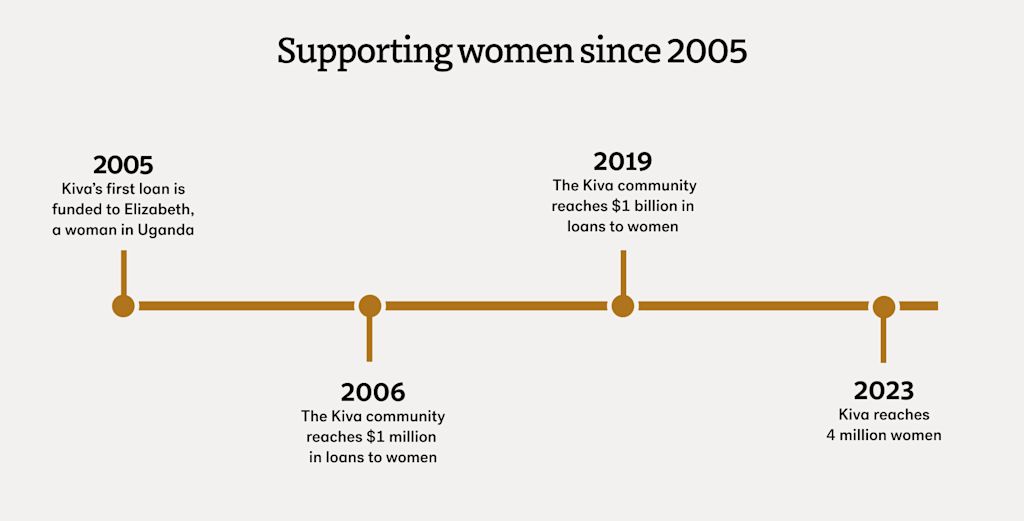
Kiva is committed to reaching 8 million underbanked women by 2028.
Read more about Kiva’s impact strategy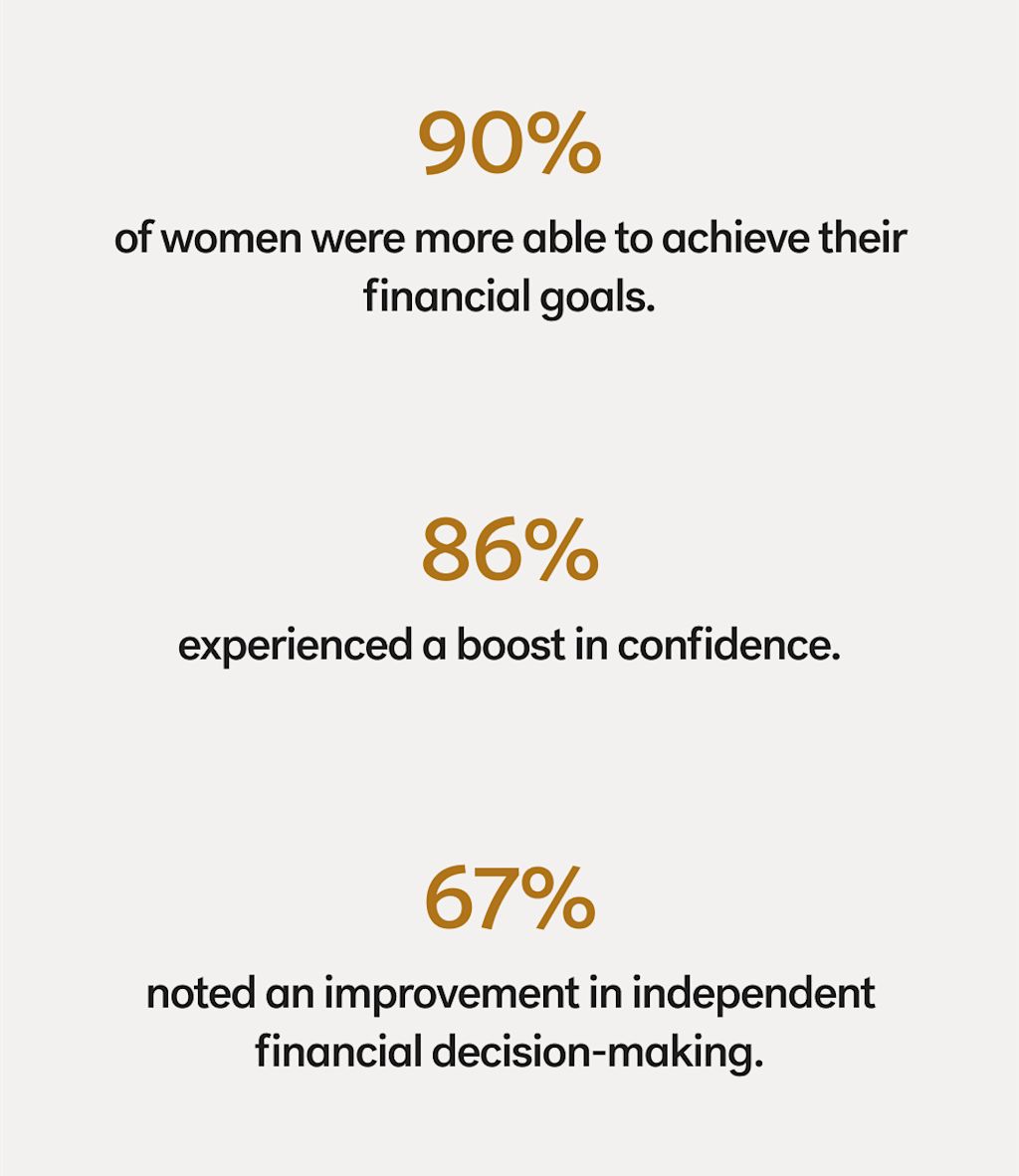
Loans to women change lives
In order to provide services and resources that meet the unique needs of women around the world, Kiva partners with local organizations that we call Lending Partners. According to an independent survey with 60 Decibels, women working with Kiva Lending Partners saw significant improvements after receiving their loan. More on the Microfinance Index report →

“I am independent… and if I am independent, I can do anything that I want at any time.”
As a growing entrepreneur, Lindiwe is investing in more than homemade juice and soda. With the support of 11 people, she’s already running three successful businesses in her community. But her true passion — mentoring and training other local women — is what drives her success.
Read Lindiwe’s story
Real women. Real progress.
Discover how small acts of support lead to big, lasting change. Get more inspiring stories like Lindiwe’s straight to your inbox.
Help a woman thrive
Stand up for gender equity by lending to women today.


Research shows that women are more likely to invest their earnings in ways that have a long-term impact on their families and communities.

Reshaping financial opportunities for women
Since the 1970s, underbanked women have been the primary users of microfinance. And while it's important to reach more women with life-changing financial services, we believe it's equally important to ensure those services are effective. That’s why we’re committed to deepening our understanding of the barriers women continue to face. With that knowledge, we can drive institutional change and create better services that transform women’s lives.
Read more on the blogWe’re dedicated to serving more women, better
In 2021, Kiva partnered with the U.S. Agency for International Development (USAID) to better understand the barriers keeping women from accessing financial services. Our Kiva Gender Lens Investing (GLI) Landscape Report found three things were needed to reach more underbanked women:
Women representation in leadership and decision making
Gender-forward policies and practices
Products and services intentionally tailored to address the barriers women face
Moved by the findings from the GLI report, Kiva launched the Gender Equity Assessment Rating (GEAR) tool in 2023. GEAR helps us understand how well an organization promotes gender equity. Kiva is committed to using GEAR to assess all Lending Partners with a gender lens by the end of 2024. Our goal? To advance gender equity within the financial system, ensuring more meaningful inclusion for women worldwide. Read more about GEAR →
Capacity building
In addition to providing funding, we help partners invest in training, research, and other initiatives to build their capacity to serve more women, better. After partnering with Kiva, many organizations receive follow-on funds from other investors and form new collaborative relationships.

Helping iDE Mozambique reach more women — even in remote areas
Many of the women without access to formal financial services live in rural areas. To help reach these women, Kiva worked with iDE Mozambique to digitize their loan products, unlocking the potential to distribute more loans every month. This digitization, plus tech integrations with Kiva, streamlined their processes — shrinking loan application time from 1 hour down to 15 minutes. This increased efficiency meant that loan officers were more willing and able to reach clients in more distant locations. It also meant that women were more likely to apply, motivated by a shorter application process. In just four months, 300 new women borrowers received loans. In a 12-month follow-up, iDE Mozambique reported they were able to grow their portfolio of women borrowers to 62% — a 15% increase.
Just over 50% of women are working worldwide, while 80% of men are employed.
Equitable financial access, for all women

132.6K refugee women supported
Displacement can amplify existing barriers to finance for women, such as labor market laws, violence, discrimination, and administrative hurdles. Employment rates of refugee women can be as low as 6%.
Learn about Kiva’s work supporting refugees and displaced communities →

313.9K climate-vulnerable women supported
Climate-related changes are impacting women at a disproportionate rate, worsening existing gender inequalities. The U.N. estimates that 80% of people displaced by climate change are women. Learn about Kiva’s work supporting climate-vulnerable populations →

6.8K marginalized U.S. women supported
Although women-owned U.S. businesses apply for traditional Ioans at a similar rate as men, less than half of their applications are approved — while businesses owned by men receive funding 61% of the time.
Learn about Kiva’s work supporting marginalized U.S. entrepreneurs →

“My business will grow and I’ll be able to provide even better services.”
— Xiomara, Ecuador
After migrating to Ecuador from Venezuela, Xiomara faced multiple tragedies. Pancreatic cancer took her daughter’s life — COVID-19 took her husband’s. Despite losing her loved ones, Xiomara refused to return to the hardships she faced in Venezuela. Now, Xiomara is the owner of Xiomi Centro de Estética Integral, where she provides facial and body treatments at her shop in Ibarra. Read Xiomara’s story →

“Before this loan, I was struggling. After receiving this loan, I started working and my kids went to school."
— Jovurane, Uganda
Jovurane lives in Uganda, where she grows bananas to sell and support her family of six. Unfortunately, poor weather led to soil erosion on her farm, which affected how many bananas she was able to produce. To secure her family’s future, Jovurane used a Kiva loan to purchase mulch and fertilizer, protecting her land from the effects of climate change and increasing her crop yield. With that income, she was able to send her children to school.

“I want to continue the legacy by taking everything that has been afforded to me and creating leaders.”
— Danielle, U.S.
Danielle grew up in the southern U.S., helping with the business her grandmother started in the 1920’s. She opened Prepped Place, her own cleaning company, in 2018 to carry on her family’s tradition of women-owned businesses. Powered by 159 people, a Kiva loan allowed Danielle to meet her immediate goals — but she’s not done. She envisions a new storefront, and the chance to provide more people with well-paying jobs. Read Danielle’s story →
Learn more about Kiva’s role in advancing gender equity

Why gender equality is so important
There is still a long way to go to achieve a world where women have access to the same opportunities as men — but there has been progress.
Read more
How microfinance providers can improve outcomes for women entrepreneurs
How microfinance providers can improve outcomes for women entrepreneurs
Read more
Access to finance is critical to help women around the world improve their earnings
Loans help to address the barriers women face in accessing finance, but their impact goes beyond the amount of money lent.
Read more