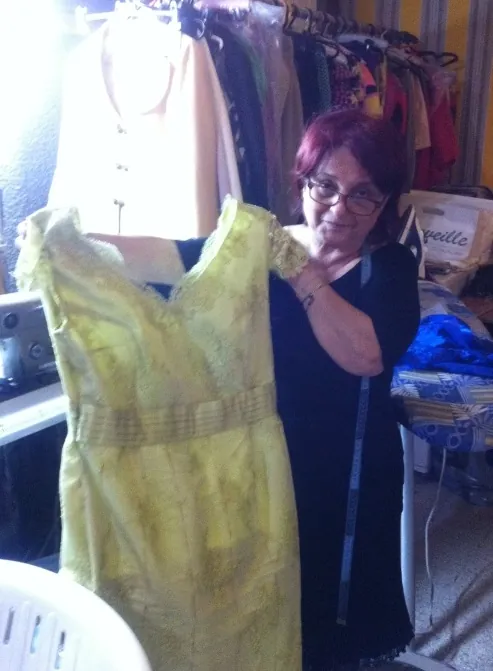
Introducing Layla, a 63-year-old widowed mother of five daughters, who sacrificed her whole life working as a tailor from her house to provide her daughters with a better standard of living and education.
Layla was, and still is, the sole breadwinner of her family. It all started at the age of 21 when she decided to learn fashion design and tailoring. She proved to be a smart learner, excelled at it, and was recruited to a well-known fashion-design atelier in Beirut.
Being the proud mother of 5 daughters, she had to put her career and dreams on hold for a long time till she met Al Majmoua, who revived her dreams and helped her set-up her own atelier.
This was 12 years ago... Since then, Al Majmoua and Layla have been working hand in hand and her business has been growing allowing her to proudly sustain the needs of her family but also create jobs for 3 women tailors.
Layla was selected to be one of 6 women entrepreneurs who displayed their collection in a fashion show that was held in December 2007, in the framework of the Women Micro Entrepreneurs and the World of Fashion project funded by Save the Children, which benefited 300 women tailors, as the outcome of a one year intensive preparation. The work of these amazing beneficiaries was recognized by Fashion TV Arabia who offered media coverage for this event.
Layla was also selected by PlaNet Finance Foundation as the “Micro-Entrepreneur of Honor” for the year 2014. She was supposed to receive her award during the 4th edition of the PlaNet Finance Foundation gala dinner which was organized under the auspices of the Cannes Film Festival with the objective of raising 200,000 Euros for the co-financing of programs in the field in order to help women entrepreneurs in Lebanon, Benin, Brazil, Egypt, France, Ghana, Madagascar, Morocco and elsewhere. The gala dinner was followed by an exclusive live auction conducted by the Artcurial Auction House.
Unfortunately, her husband’s health was very critical, so she decided to stay next to him during his remaining few days and couldn’t attend the event. He passed away leaving her alone again with her five daughters and successful career to move on.
With strength and determination, Layla succeeded in providing better standards of living to her 5 daughters and as well as 3 women dressmakers through the creation of job opportunities. She had the chance to contribute to her daughters’ wedding expenses, in addition to urgent medical needs.
Layla has acquired a wide experience in this domain with her greatest features being evening gowns and wedding dresses.
Today, Layla is acquiring her eleventh loan cycle from Kiva’s field partner Al Majmoua in order to buy necessary fabrics, textiles and accessories requested for her new designs, especially for the autumn and winter collection and the Holy Christmas and New Year seasons.
Respected and trusted by all, Layla naturally became a role model and peer trainer for other female micro-entrepreneur beneficiaries of the Al Majmoua program.
 Adding to basket
Funded
Layla

Repayment schedule
Monthly: One repayment made per month
End of term: One repayment made at the end of the loan term
Irregular: Any other repayment schedule
To see a detailed repayment schedule for a specific loan, click the "Repayment schedule" link on the loan profile under "Loan details."
What is the disbursed date?
In the case of partner loans, many of our Lending Partners choose to disburse loan funds before the loan request is posted on Kiva. We allow pre-disbursal because it ensures that the funds reach the borrower as soon as they are needed. Loan funds from Kiva lenders then go to backfill that amount and as a lender you assume the risk of the loan. By doing this, our Lending Partners assume the risk that, if the loan isn't funded by lenders, they will have to fund the loan without any funds from Kiva.
If a partner loan is not pre-disbursed, it will be listed on Kiva with an expected "post-disbursed" date. If a post-disbursed loan is not funded on Kiva, there is a chance that the borrower may not receive their loan. Some Lending Partners choose to disburse loans with other sources of funding, while other partners don't have the resources available to fund loans without Kiva lenders' support. No direct loans will be disbursed unless they fully fundraise on Kiva.
Funding model
What does "Partner covers currency loss" mean & how could it affect my Kiva loans?
Potential for currency exchange loss is noted on every loan profile under the loan details:
"Yes" means the Lending Partner will cover any currency loss. Lenders will not bear losses due to currency fluctuation
"Partial" means that the Lending Partner has opted to cover losses only up to 10%. If the U.S. dollar appreciates more than 10% against the local currency, those losses will be passed onto lenders.
"No" means that the Lending Partner is not covering any currency losses and all losses will be passed onto lenders.
"N/A" means the Lending Partner disburses loans to borrowers in USD so their loans are not subject to any currency fluctuation.
Do Kiva borrowers pay any interest on their loans?
Our partners collect interest from borrowers because there are many operational expenses associated with microfinance in developing markets, especially in rural areas. Many of Kiva's Lending Partners also provide additional services alongside their loan products such as business training, financial literacy lessons, or health services.
Kiva will not partner with an organization that charges unreasonable interest rates, and we require Lending Partners to fully disclose their rates. In addition, we only partner with microfinance institutions and organizations that have a social mission to serve the poor, unbanked, and underserved.
There are some 0% interest loans on Kiva, including all direct loans in the United States. To learn more about the interest rates Kiva borrowers pay, you can review the "Average cost to borrower" field on a loan profile.
We also encourage you to read the following articles if you are interested in further educating yourself on the topic: Microfinance 101 (https://www.kiva.org/microfinance), Top 10 things to know about microfinance (https://www.kiva.org/blog/top-10-things-to-know-about-microfinance), Microfinance interest rates explained (https://www.kiva.org/blog/whats-up-with-microfinance-interest-rates)
What is a risk rating?
The Lending Partner risk rating reflects the risk of institutional default associated with each of Kiva’s Lending Partners. A 0.5-star rating means the organization has a relatively higher risk of institutional default, while a 5-star rating indicates the organization is at a relatively lower risk of default, based on Kiva's analysis and the available information displayed in the Lending Partner section of every loan. Lending Partners with the lowest credit tier undergo a lighter level of due diligence and do not receive a risk rating; instead, in places where a risk rating would normally appear, these partners are labeled as “Experimental.” For more information, see "What is an Experimental Lending Partner?"
Direct loans also do not receive a formal risk rating. Instead, these loans are approved through “social underwriting”, where trustworthiness is determined by friends & family lending a portion of the loan request, or by a Kiva approved Trustee vouching for the borrower. Direct loans will appear as "Unrated" and lenders should always assume these loans represent the highest level of repayment risk on Kiva.
How are loans facilitated?
Kiva loans are facilitated through 2 models, partner and direct, that enable us to reach the greatest number of people around the world.
For partner loans, borrowers apply to a local Lending Partner, which manages the loan on the ground. Lending Partners are responsible for screening borrowers, disbursing loans, posting borrowers to the Kiva website for funding, collecting repayments and otherwise administering Kiva loans on the ground to borrowers.
For direct loans, borrowers apply through the Kiva website and may or may not be endorsed by a Trustee. Unlike Lending Partners, Trustees don't handle any financial transactions or have any duty to repay loans on behalf of their borrowers. Instead, Trustees take the role of providing support and business advice to their borrowers throughout the term of the loan.
More information about successive and concurrent loans
Most borrowers take out loans consecutively, meaning that they receive a second loan after having repaid the first. However, sometimes our Lending Partners give out concurrent loans, allowing borrowers to take out one primary loan and a secondary "add-on" loan along with it. These additional loans are typically smaller than the borrower's primary loan and serve a different purpose. We trust our partners to determine whether a borrower has the means to be able to repay a successive or concurrent loan.
A loan helped to buy necessary fabrics, textiles and accessories requested for her new designs, especially for the autumn and winter collection and the Holy Christmas and New Year seasons.
Layla's story
More about this loan
About Al Majmoua (former):
The Lebanese Association for Development ? Al Majmoua is Lebanon?s leading microfinance institution and the oldest Kiva partner in Lebanon. Al Majmoua?s vision is to ?be the leader in creating an inclusive financial system where all people in Lebanon have access to affordable services.? Given Lebanon's diverse population, Al Majmoua lends to all nationalities, provided legal residency. The strong financial position achieved to date has allowed Al Majmoua to steadily lower its pricing over the years.
Based on the belief that non-financial services play a complementary role in improving the quality of life of the most vulnerable entrepreneurs, Al Majmoua has established a solid Business Development Services program for both borrowers and non-borrowers with a focus on women and youth.
Loan details
Loan length:
Repayment schedule
Monthly: One repayment made per month
End of term: One repayment made at the end of the loan term
Irregular: Any other repayment schedule
To see a detailed repayment schedule for a specific loan, click the "Repayment schedule" link on the loan profile under "Loan details."
What is the disbursed date?
In the case of partner loans, many of our Lending Partners choose to disburse loan funds before the loan request is posted on Kiva. We allow pre-disbursal because it ensures that the funds reach the borrower as soon as they are needed. Loan funds from Kiva lenders then go to backfill that amount and as a lender you assume the risk of the loan. By doing this, our Lending Partners assume the risk that, if the loan isn't funded by lenders, they will have to fund the loan without any funds from Kiva.
If a partner loan is not pre-disbursed, it will be listed on Kiva with an expected "post-disbursed" date. If a post-disbursed loan is not funded on Kiva, there is a chance that the borrower may not receive their loan. Some Lending Partners choose to disburse loans with other sources of funding, while other partners don't have the resources available to fund loans without Kiva lenders' support. No direct loans will be disbursed unless they fully fundraise on Kiva.
Funding model
What does "Partner covers currency loss" mean & how could it affect my Kiva loans?
Potential for currency exchange loss is noted on every loan profile under the loan details:
"Yes" means the Lending Partner will cover any currency loss. Lenders will not bear losses due to currency fluctuation
"Partial" means that the Lending Partner has opted to cover losses only up to 10%. If the U.S. dollar appreciates more than 10% against the local currency, those losses will be passed onto lenders.
"No" means that the Lending Partner is not covering any currency losses and all losses will be passed onto lenders.
"N/A" means the Lending Partner disburses loans to borrowers in USD so their loans are not subject to any currency fluctuation.
Do Kiva borrowers pay any interest on their loans?
Our partners collect interest from borrowers because there are many operational expenses associated with microfinance in developing markets, especially in rural areas. Many of Kiva's Lending Partners also provide additional services alongside their loan products such as business training, financial literacy lessons, or health services.
Kiva will not partner with an organization that charges unreasonable interest rates, and we require Lending Partners to fully disclose their rates. In addition, we only partner with microfinance institutions and organizations that have a social mission to serve the poor, unbanked, and underserved.
There are some 0% interest loans on Kiva, including all direct loans in the United States. To learn more about the interest rates Kiva borrowers pay, you can review the "Average cost to borrower" field on a loan profile.
We also encourage you to read the following articles if you are interested in further educating yourself on the topic: Microfinance 101 (https://www.kiva.org/microfinance), Top 10 things to know about microfinance (https://www.kiva.org/blog/top-10-things-to-know-about-microfinance), Microfinance interest rates explained (https://www.kiva.org/blog/whats-up-with-microfinance-interest-rates)
What is a risk rating?
The Lending Partner risk rating reflects the risk of institutional default associated with each of Kiva’s Lending Partners. A 0.5-star rating means the organization has a relatively higher risk of institutional default, while a 5-star rating indicates the organization is at a relatively lower risk of default, based on Kiva's analysis and the available information displayed in the Lending Partner section of every loan. Lending Partners with the lowest credit tier undergo a lighter level of due diligence and do not receive a risk rating; instead, in places where a risk rating would normally appear, these partners are labeled as “Experimental.” For more information, see "What is an Experimental Lending Partner?"
Direct loans also do not receive a formal risk rating. Instead, these loans are approved through “social underwriting”, where trustworthiness is determined by friends & family lending a portion of the loan request, or by a Kiva approved Trustee vouching for the borrower. Direct loans will appear as "Unrated" and lenders should always assume these loans represent the highest level of repayment risk on Kiva.
How are loans facilitated?
Kiva loans are facilitated through 2 models, partner and direct, that enable us to reach the greatest number of people around the world.
For partner loans, borrowers apply to a local Lending Partner, which manages the loan on the ground. Lending Partners are responsible for screening borrowers, disbursing loans, posting borrowers to the Kiva website for funding, collecting repayments and otherwise administering Kiva loans on the ground to borrowers.
For direct loans, borrowers apply through the Kiva website and may or may not be endorsed by a Trustee. Unlike Lending Partners, Trustees don't handle any financial transactions or have any duty to repay loans on behalf of their borrowers. Instead, Trustees take the role of providing support and business advice to their borrowers throughout the term of the loan.
More information about successive and concurrent loans
Most borrowers take out loans consecutively, meaning that they receive a second loan after having repaid the first. However, sometimes our Lending Partners give out concurrent loans, allowing borrowers to take out one primary loan and a secondary "add-on" loan along with it. These additional loans are typically smaller than the borrower's primary loan and serve a different purpose. We trust our partners to determine whether a borrower has the means to be able to repay a successive or concurrent loan.
Lenders and lending teams
Country: Lebanon
Lending Partner: Al Majmoua (former)

Average cost to borrower (PY)
What does "Profitability (Return on Assets)" mean?
Average loan size (% of per capita income)
A Lending Partner's average loan size is expressed as a percentage of the country's gross national annual income per capita. Loans that are smaller (that is, as a lower percentage of gross national income per capita) are generally made to more economically disadvantaged populations. However, these same loans are generally more costly for the Lending Partner to originate, disburse and collect.
Partner delinquency (arrears) rate
How this is calculated: delinquency (arrears) rate = $ value of payments past due of delinquent paying back loans / outstanding $ value of all paying back loans
Loans at risk rate
Lending Partner's default rate
How this is calculated: default rate = amount of ended loans defaulted / amount of ended loans
Notes:
- Many Lending Partners do not yet have many ended loans due to their short history on Kiva (see "Time on Kiva"). If this is the case, a more meaningful indicator of principal risk is "delinquency rate."
- At Kiva, we define default (non-repayment) as: the time when Kiva determines that collection of funds from a borrower or partner is doubtful, or the cumulative amount repaid as of a quarterly reconciliation is less than the amount expected as of 360 days prior and there have been no repayments reported to Kiva during this time.
Kiva typically processes defaults on a semiannual basis, and case by case exceptions may be made if the partner or Kiva anticipates future repayments to be made on the loan. Lending Partners also have the option to default loans at any time, should they determine that further collection of loan repayments from the borrower is unlikely.
What's a Lending Partner?
Our Lending Partners are nonprofit organizations, microfinance institutions, schools, and social enterprises. Many provide services alongside their loans, such as entrepreneurial training or finanical literacy development. Our partners all share one thing in common: a desire to improve people's lives through access to safe and affordable credit. You can see a list of Kiva Lending Partners here: kiva.org/partners
Tags
Loan tags help lenders find loans that match certain areas of interest.
Loan details
Loan length:
Repayment schedule
Monthly: One repayment made per month
End of term: One repayment made at the end of the loan term
Irregular: Any other repayment schedule
To see a detailed repayment schedule for a specific loan, click the "Repayment schedule" link on the loan profile under "Loan details."
What is the disbursed date?
In the case of partner loans, many of our Lending Partners choose to disburse loan funds before the loan request is posted on Kiva. We allow pre-disbursal because it ensures that the funds reach the borrower as soon as they are needed. Loan funds from Kiva lenders then go to backfill that amount and as a lender you assume the risk of the loan. By doing this, our Lending Partners assume the risk that, if the loan isn't funded by lenders, they will have to fund the loan without any funds from Kiva.
If a partner loan is not pre-disbursed, it will be listed on Kiva with an expected "post-disbursed" date. If a post-disbursed loan is not funded on Kiva, there is a chance that the borrower may not receive their loan. Some Lending Partners choose to disburse loans with other sources of funding, while other partners don't have the resources available to fund loans without Kiva lenders' support. No direct loans will be disbursed unless they fully fundraise on Kiva.
Funding model
What does "Partner covers currency loss" mean & how could it affect my Kiva loans?
Potential for currency exchange loss is noted on every loan profile under the loan details:
"Yes" means the Lending Partner will cover any currency loss. Lenders will not bear losses due to currency fluctuation
"Partial" means that the Lending Partner has opted to cover losses only up to 10%. If the U.S. dollar appreciates more than 10% against the local currency, those losses will be passed onto lenders.
"No" means that the Lending Partner is not covering any currency losses and all losses will be passed onto lenders.
"N/A" means the Lending Partner disburses loans to borrowers in USD so their loans are not subject to any currency fluctuation.
Do Kiva borrowers pay any interest on their loans?
Our partners collect interest from borrowers because there are many operational expenses associated with microfinance in developing markets, especially in rural areas. Many of Kiva's Lending Partners also provide additional services alongside their loan products such as business training, financial literacy lessons, or health services.
Kiva will not partner with an organization that charges unreasonable interest rates, and we require Lending Partners to fully disclose their rates. In addition, we only partner with microfinance institutions and organizations that have a social mission to serve the poor, unbanked, and underserved.
There are some 0% interest loans on Kiva, including all direct loans in the United States. To learn more about the interest rates Kiva borrowers pay, you can review the "Average cost to borrower" field on a loan profile.
We also encourage you to read the following articles if you are interested in further educating yourself on the topic: Microfinance 101 (https://www.kiva.org/microfinance), Top 10 things to know about microfinance (https://www.kiva.org/blog/top-10-things-to-know-about-microfinance), Microfinance interest rates explained (https://www.kiva.org/blog/whats-up-with-microfinance-interest-rates)
What is a risk rating?
The Lending Partner risk rating reflects the risk of institutional default associated with each of Kiva’s Lending Partners. A 0.5-star rating means the organization has a relatively higher risk of institutional default, while a 5-star rating indicates the organization is at a relatively lower risk of default, based on Kiva's analysis and the available information displayed in the Lending Partner section of every loan. Lending Partners with the lowest credit tier undergo a lighter level of due diligence and do not receive a risk rating; instead, in places where a risk rating would normally appear, these partners are labeled as “Experimental.” For more information, see "What is an Experimental Lending Partner?"
Direct loans also do not receive a formal risk rating. Instead, these loans are approved through “social underwriting”, where trustworthiness is determined by friends & family lending a portion of the loan request, or by a Kiva approved Trustee vouching for the borrower. Direct loans will appear as "Unrated" and lenders should always assume these loans represent the highest level of repayment risk on Kiva.
How are loans facilitated?
Kiva loans are facilitated through 2 models, partner and direct, that enable us to reach the greatest number of people around the world.
For partner loans, borrowers apply to a local Lending Partner, which manages the loan on the ground. Lending Partners are responsible for screening borrowers, disbursing loans, posting borrowers to the Kiva website for funding, collecting repayments and otherwise administering Kiva loans on the ground to borrowers.
For direct loans, borrowers apply through the Kiva website and may or may not be endorsed by a Trustee. Unlike Lending Partners, Trustees don't handle any financial transactions or have any duty to repay loans on behalf of their borrowers. Instead, Trustees take the role of providing support and business advice to their borrowers throughout the term of the loan.
More information about successive and concurrent loans
Most borrowers take out loans consecutively, meaning that they receive a second loan after having repaid the first. However, sometimes our Lending Partners give out concurrent loans, allowing borrowers to take out one primary loan and a secondary "add-on" loan along with it. These additional loans are typically smaller than the borrower's primary loan and serve a different purpose. We trust our partners to determine whether a borrower has the means to be able to repay a successive or concurrent loan.
Lending Partner: Al Majmoua (former)
Average cost to borrower (PY)
What does "Profitability (Return on Assets)" mean?
Average loan size (% of per capita income)
A Lending Partner's average loan size is expressed as a percentage of the country's gross national annual income per capita. Loans that are smaller (that is, as a lower percentage of gross national income per capita) are generally made to more economically disadvantaged populations. However, these same loans are generally more costly for the Lending Partner to originate, disburse and collect.
Partner delinquency (arrears) rate
How this is calculated: delinquency (arrears) rate = $ value of payments past due of delinquent paying back loans / outstanding $ value of all paying back loans
Loans at risk rate
Lending Partner's default rate
How this is calculated: default rate = amount of ended loans defaulted / amount of ended loans
Notes:
- Many Lending Partners do not yet have many ended loans due to their short history on Kiva (see "Time on Kiva"). If this is the case, a more meaningful indicator of principal risk is "delinquency rate."
- At Kiva, we define default (non-repayment) as: the time when Kiva determines that collection of funds from a borrower or partner is doubtful, or the cumulative amount repaid as of a quarterly reconciliation is less than the amount expected as of 360 days prior and there have been no repayments reported to Kiva during this time.
Kiva typically processes defaults on a semiannual basis, and case by case exceptions may be made if the partner or Kiva anticipates future repayments to be made on the loan. Lending Partners also have the option to default loans at any time, should they determine that further collection of loan repayments from the borrower is unlikely.
What's a Lending Partner?
Our Lending Partners are nonprofit organizations, microfinance institutions, schools, and social enterprises. Many provide services alongside their loans, such as entrepreneurial training or finanical literacy development. Our partners all share one thing in common: a desire to improve people's lives through access to safe and affordable credit. You can see a list of Kiva Lending Partners here: kiva.org/partners
You are opting out of using Free Trial.
You have selected to not use your Free Trial and will be prompted to pay for this loan using your own money.
Agree Use a Free TrialShoot! This loan is ineligible.
Your free credit can't be applied to this loan. If you would like to make a loan to this borrower anyway, you will have to use your own money.
Lend Anyway Find an Eligible LoanYou cannot use your Free Trial to support this loan.
Free Trials cannot be used to make loans during their private fundraising period on Kiva. If you would like to lend to this borrower anyway, you will have to use your own money.
Agree Find an Eligible Loan