BagoSphere is a vocational training company that enables rural youth to gain quick access to gainful employment. BagoSphere provides a unique combination of communication, critical thinking, and life skills training, in just two months, to rural youth. With those skills, rural youth become skilled communicators, and they become highly desired by the call center industry in the Philippines.
With a success rate of 80 percent, BagoSphere’s program enables rural youth to experience a seamless transition from training to working in a multi-national company.
Rural youth form a large base of untapped talent in the Philippines. BagoSphere aims to unlock their talents, to boost the manpower supply for call centers and business process outsourcing (BPO) companies in Bacolod City, thereby fueling the growth of the industry. In turn, the call center jobs provide youth with incomes that are four times higher than unskilled work, enabling them to save toward pursuing their professional and personal development goals.
BagoSphere is the recipient of Singapore International Foundation’s Young Social Entrepreneurs Grant Program and an award winner of Start-up@Singapore’s Social Enterprise competition in 2012. BagoSphere was incubated by Social Venture Lab at the National University of Singapore (NUS). BagoSphere is also supported by Kickstart Ventures (a subsidiary of Globe Telecom), Co.Lab Xchange Incubator, the Small World Group Incubator (SWGI), Impact Investment Exchange (Asia), and the Bago City local government. In addition, it is a member of Innov8 Sparks, the network of technology startup support and funding initiatives founded by members of the SingTel Group.
BagoSphere seeks expansion capital. Being a pioneer in training out-of-school youth for business process outsourcing firms (BPOs) in rural Philippines, BagoSphere has developed a core set of tools, and experience in getting youth into call center jobs. Piloted in Negros Occidental by BagoSphere since 2011, BagoSphere's program has been able to consistently train out-of-school youth in two months to become call center agents, hired by top call centers in Bacolod City. BagoSphere’s partner employers include Teleperformance, Transcom, Teletech, Convergys and Panasiatic Solutions. BagoSphere has trained 103 out-of-school youth to date, and 85% of them found call center jobs within two months of graduation. Dedicated to the social cause of empowering youth with full-time employment, BagoSphere’s engagement with its students lasts beyond the training period. As a result, the long-term (over six months after graduation) employment rate is sustained at over 60%.
BagoSphere’s curriculum was developed with out-of-school youth employment in mind. This involves English communications, IT, financial literacy, and life skills. Already in its seventh iteration, BagoSphere’s curriculum features confidence building and value formation (e.g., professional work ethics, cultivating focus and discipline), integrated into everyday lessons. On the execution end, BagoSphere employs former call center trainers to deliver high-quality training. With a blended revenue model of tuition fees and placement fees, BagoSphere has been able to execute a model that is financially sustainable and helps BPOs save on recruitment costs. Out-of-school youth take a micro-finance loan from NWTF or from BagoSphere, in a "study-now-pay-later” scheme to finance their studies, while BPOs pay BagoSphere a placement fee for every hire.
Having worked with NWTF in 2013, BagoSphere believes that the two organizations' interests are closely aligned. NWTF’s special education loan enables BagoSphere to reduce its operational risk in debt collection, which is not the core strength of BagoSphere. At the same time, NWTF can leverage BagoSphere’s expertise in training youth, to decrease the risk of their educational loans.
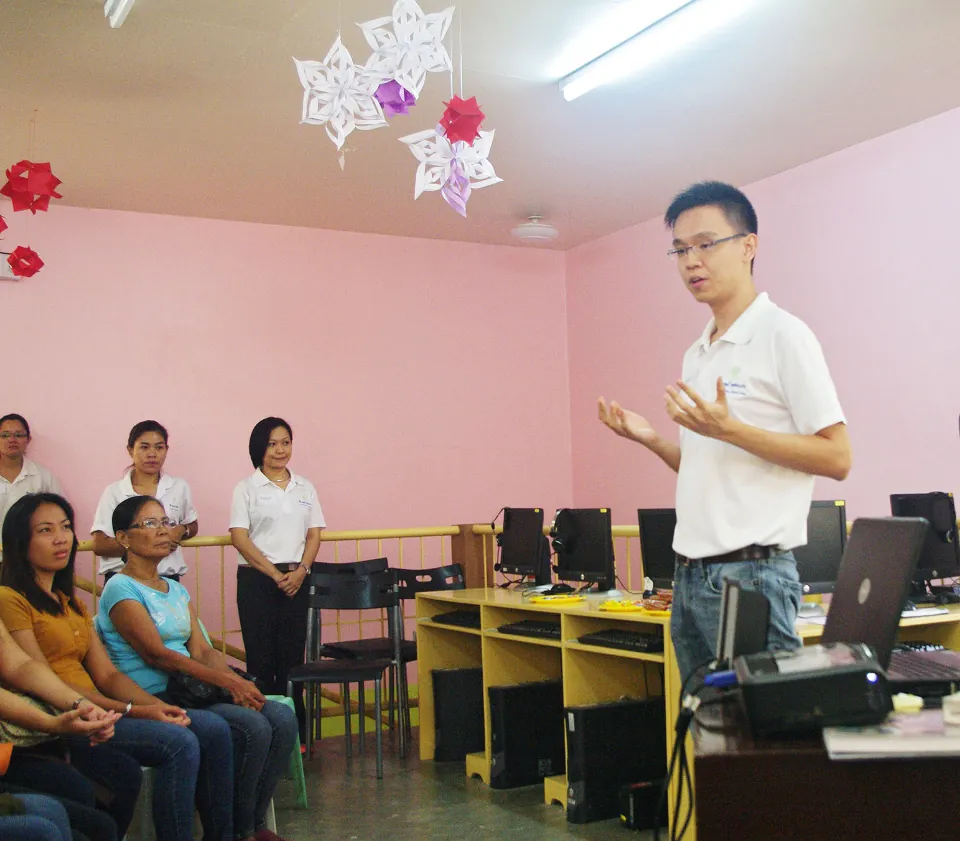
The photo features BagoSphere's CEO, Zhihan, as well as other BagoSphere staff and students.
 Adding to basket
Funded
Bagosphere

Repayment schedule
Monthly: One repayment made per month
End of term: One repayment made at the end of the loan term
Irregular: Any other repayment schedule
To see a detailed repayment schedule for a specific loan, click the "Repayment schedule" link on the loan profile under "Loan details."
What is the disbursed date?
In the case of partner loans, many of our Lending Partners choose to disburse loan funds before the loan request is posted on Kiva. We allow pre-disbursal because it ensures that the funds reach the borrower as soon as they are needed. Loan funds from Kiva lenders then go to backfill that amount and as a lender you assume the risk of the loan. By doing this, our Lending Partners assume the risk that, if the loan isn't funded by lenders, they will have to fund the loan without any funds from Kiva.
If a partner loan is not pre-disbursed, it will be listed on Kiva with an expected "post-disbursed" date. If a post-disbursed loan is not funded on Kiva, there is a chance that the borrower may not receive their loan. Some Lending Partners choose to disburse loans with other sources of funding, while other partners don't have the resources available to fund loans without Kiva lenders' support. No direct loans will be disbursed unless they fully fundraise on Kiva.
Funding model
What does "Partner covers currency loss" mean & how could it affect my Kiva loans?
Potential for currency exchange loss is noted on every loan profile under the loan details:
"Yes" means the Lending Partner will cover any currency loss. Lenders will not bear losses due to currency fluctuation
"Partial" means that the Lending Partner has opted to cover losses only up to 10%. If the U.S. dollar appreciates more than 10% against the local currency, those losses will be passed onto lenders.
"No" means that the Lending Partner is not covering any currency losses and all losses will be passed onto lenders.
"N/A" means the Lending Partner disburses loans to borrowers in USD so their loans are not subject to any currency fluctuation.
Do Kiva borrowers pay any interest on their loans?
Our partners collect interest from borrowers because there are many operational expenses associated with microfinance in developing markets, especially in rural areas. Many of Kiva's Lending Partners also provide additional services alongside their loan products such as business training, financial literacy lessons, or health services.
Kiva will not partner with an organization that charges unreasonable interest rates, and we require Lending Partners to fully disclose their rates. In addition, we only partner with microfinance institutions and organizations that have a social mission to serve the poor, unbanked, and underserved.
There are some 0% interest loans on Kiva, including all direct loans in the United States. To learn more about the interest rates Kiva borrowers pay, you can review the "Average cost to borrower" field on a loan profile.
We also encourage you to read the following articles if you are interested in further educating yourself on the topic: Microfinance 101 (https://www.kiva.org/microfinance), Top 10 things to know about microfinance (https://www.kiva.org/blog/top-10-things-to-know-about-microfinance), Microfinance interest rates explained (https://www.kiva.org/blog/whats-up-with-microfinance-interest-rates)
What is a risk rating?
The Lending Partner risk rating reflects the risk of institutional default associated with each of Kiva’s Lending Partners. A 0.5-star rating means the organization has a relatively higher risk of institutional default, while a 5-star rating indicates the organization is at a relatively lower risk of default, based on Kiva's analysis and the available information displayed in the Lending Partner section of every loan. Lending Partners with the lowest credit tier undergo a lighter level of due diligence and do not receive a risk rating; instead, in places where a risk rating would normally appear, these partners are labeled as “Experimental.” For more information, see "What is an Experimental Lending Partner?"
Direct loans also do not receive a formal risk rating. Instead, these loans are approved through “social underwriting”, where trustworthiness is determined by friends & family lending a portion of the loan request, or by a Kiva approved Trustee vouching for the borrower. Direct loans will appear as "Unrated" and lenders should always assume these loans represent the highest level of repayment risk on Kiva.
How are loans facilitated?
Kiva loans are facilitated through 2 models, partner and direct, that enable us to reach the greatest number of people around the world.
For partner loans, borrowers apply to a local Lending Partner, which manages the loan on the ground. Lending Partners are responsible for screening borrowers, disbursing loans, posting borrowers to the Kiva website for funding, collecting repayments and otherwise administering Kiva loans on the ground to borrowers.
For direct loans, borrowers apply through the Kiva website and may or may not be endorsed by a Trustee. Unlike Lending Partners, Trustees don't handle any financial transactions or have any duty to repay loans on behalf of their borrowers. Instead, Trustees take the role of providing support and business advice to their borrowers throughout the term of the loan.
More information about successive and concurrent loans
Most borrowers take out loans consecutively, meaning that they receive a second loan after having repaid the first. However, sometimes our Lending Partners give out concurrent loans, allowing borrowers to take out one primary loan and a secondary "add-on" loan along with it. These additional loans are typically smaller than the borrower's primary loan and serve a different purpose. We trust our partners to determine whether a borrower has the means to be able to repay a successive or concurrent loan.
A loan helped to pay for expansion of operations and staff enhancement training, and employ additional working capital.
Bagosphere's story
More about this loan
About Negros Women for Tomorrow Foundation (NWTF):
Negros Women for Tomorrow Foundation (NWTF) is a non-governmental organization established with the aim to help women achieve self-sufficiency, particularly in the province of Negros Occidental's low-income communities. The organization offers its clients a wide variety of products, including loans for micro-entrepreneurs, hospital income benefits, life insurance, accidental death benefits and more. Kiva lenders' funds will be used to expand the reach of these products to low-income urban and rural communities.
Loan details
Loan length:
Repayment schedule
Monthly: One repayment made per month
End of term: One repayment made at the end of the loan term
Irregular: Any other repayment schedule
To see a detailed repayment schedule for a specific loan, click the "Repayment schedule" link on the loan profile under "Loan details."
What is the disbursed date?
In the case of partner loans, many of our Lending Partners choose to disburse loan funds before the loan request is posted on Kiva. We allow pre-disbursal because it ensures that the funds reach the borrower as soon as they are needed. Loan funds from Kiva lenders then go to backfill that amount and as a lender you assume the risk of the loan. By doing this, our Lending Partners assume the risk that, if the loan isn't funded by lenders, they will have to fund the loan without any funds from Kiva.
If a partner loan is not pre-disbursed, it will be listed on Kiva with an expected "post-disbursed" date. If a post-disbursed loan is not funded on Kiva, there is a chance that the borrower may not receive their loan. Some Lending Partners choose to disburse loans with other sources of funding, while other partners don't have the resources available to fund loans without Kiva lenders' support. No direct loans will be disbursed unless they fully fundraise on Kiva.
Funding model
What does "Partner covers currency loss" mean & how could it affect my Kiva loans?
Potential for currency exchange loss is noted on every loan profile under the loan details:
"Yes" means the Lending Partner will cover any currency loss. Lenders will not bear losses due to currency fluctuation
"Partial" means that the Lending Partner has opted to cover losses only up to 10%. If the U.S. dollar appreciates more than 10% against the local currency, those losses will be passed onto lenders.
"No" means that the Lending Partner is not covering any currency losses and all losses will be passed onto lenders.
"N/A" means the Lending Partner disburses loans to borrowers in USD so their loans are not subject to any currency fluctuation.
Do Kiva borrowers pay any interest on their loans?
Our partners collect interest from borrowers because there are many operational expenses associated with microfinance in developing markets, especially in rural areas. Many of Kiva's Lending Partners also provide additional services alongside their loan products such as business training, financial literacy lessons, or health services.
Kiva will not partner with an organization that charges unreasonable interest rates, and we require Lending Partners to fully disclose their rates. In addition, we only partner with microfinance institutions and organizations that have a social mission to serve the poor, unbanked, and underserved.
There are some 0% interest loans on Kiva, including all direct loans in the United States. To learn more about the interest rates Kiva borrowers pay, you can review the "Average cost to borrower" field on a loan profile.
We also encourage you to read the following articles if you are interested in further educating yourself on the topic: Microfinance 101 (https://www.kiva.org/microfinance), Top 10 things to know about microfinance (https://www.kiva.org/blog/top-10-things-to-know-about-microfinance), Microfinance interest rates explained (https://www.kiva.org/blog/whats-up-with-microfinance-interest-rates)
What is a risk rating?
The Lending Partner risk rating reflects the risk of institutional default associated with each of Kiva’s Lending Partners. A 0.5-star rating means the organization has a relatively higher risk of institutional default, while a 5-star rating indicates the organization is at a relatively lower risk of default, based on Kiva's analysis and the available information displayed in the Lending Partner section of every loan. Lending Partners with the lowest credit tier undergo a lighter level of due diligence and do not receive a risk rating; instead, in places where a risk rating would normally appear, these partners are labeled as “Experimental.” For more information, see "What is an Experimental Lending Partner?"
Direct loans also do not receive a formal risk rating. Instead, these loans are approved through “social underwriting”, where trustworthiness is determined by friends & family lending a portion of the loan request, or by a Kiva approved Trustee vouching for the borrower. Direct loans will appear as "Unrated" and lenders should always assume these loans represent the highest level of repayment risk on Kiva.
How are loans facilitated?
Kiva loans are facilitated through 2 models, partner and direct, that enable us to reach the greatest number of people around the world.
For partner loans, borrowers apply to a local Lending Partner, which manages the loan on the ground. Lending Partners are responsible for screening borrowers, disbursing loans, posting borrowers to the Kiva website for funding, collecting repayments and otherwise administering Kiva loans on the ground to borrowers.
For direct loans, borrowers apply through the Kiva website and may or may not be endorsed by a Trustee. Unlike Lending Partners, Trustees don't handle any financial transactions or have any duty to repay loans on behalf of their borrowers. Instead, Trustees take the role of providing support and business advice to their borrowers throughout the term of the loan.
More information about successive and concurrent loans
Most borrowers take out loans consecutively, meaning that they receive a second loan after having repaid the first. However, sometimes our Lending Partners give out concurrent loans, allowing borrowers to take out one primary loan and a secondary "add-on" loan along with it. These additional loans are typically smaller than the borrower's primary loan and serve a different purpose. We trust our partners to determine whether a borrower has the means to be able to repay a successive or concurrent loan.
Lenders and lending teams
Country: Philippines
Lending Partner: Negros Women for Tomorrow Foundation (NWTF)

Average cost to borrower (PY)
What does "Profitability (Return on Assets)" mean?
Average loan size (% of per capita income)
A Lending Partner's average loan size is expressed as a percentage of the country's gross national annual income per capita. Loans that are smaller (that is, as a lower percentage of gross national income per capita) are generally made to more economically disadvantaged populations. However, these same loans are generally more costly for the Lending Partner to originate, disburse and collect.
Partner delinquency (arrears) rate
How this is calculated: delinquency (arrears) rate = $ value of payments past due of delinquent paying back loans / outstanding $ value of all paying back loans
Loans at risk rate
Lending Partner's default rate
How this is calculated: default rate = amount of ended loans defaulted / amount of ended loans
Notes:
- Many Lending Partners do not yet have many ended loans due to their short history on Kiva (see "Time on Kiva"). If this is the case, a more meaningful indicator of principal risk is "delinquency rate."
- At Kiva, we define default (non-repayment) as: the time when Kiva determines that collection of funds from a borrower or partner is doubtful, or the cumulative amount repaid as of a quarterly reconciliation is less than the amount expected as of 360 days prior and there have been no repayments reported to Kiva during this time.
Kiva typically processes defaults on a semiannual basis, and case by case exceptions may be made if the partner or Kiva anticipates future repayments to be made on the loan. Lending Partners also have the option to default loans at any time, should they determine that further collection of loan repayments from the borrower is unlikely.
What's a Lending Partner?
Our Lending Partners are nonprofit organizations, microfinance institutions, schools, and social enterprises. Many provide services alongside their loans, such as entrepreneurial training or finanical literacy development. Our partners all share one thing in common: a desire to improve people's lives through access to safe and affordable credit. You can see a list of Kiva Lending Partners here: kiva.org/partners
Tags
Loan tags help lenders find loans that match certain areas of interest.
Loan details
Loan length:
Repayment schedule
Monthly: One repayment made per month
End of term: One repayment made at the end of the loan term
Irregular: Any other repayment schedule
To see a detailed repayment schedule for a specific loan, click the "Repayment schedule" link on the loan profile under "Loan details."
What is the disbursed date?
In the case of partner loans, many of our Lending Partners choose to disburse loan funds before the loan request is posted on Kiva. We allow pre-disbursal because it ensures that the funds reach the borrower as soon as they are needed. Loan funds from Kiva lenders then go to backfill that amount and as a lender you assume the risk of the loan. By doing this, our Lending Partners assume the risk that, if the loan isn't funded by lenders, they will have to fund the loan without any funds from Kiva.
If a partner loan is not pre-disbursed, it will be listed on Kiva with an expected "post-disbursed" date. If a post-disbursed loan is not funded on Kiva, there is a chance that the borrower may not receive their loan. Some Lending Partners choose to disburse loans with other sources of funding, while other partners don't have the resources available to fund loans without Kiva lenders' support. No direct loans will be disbursed unless they fully fundraise on Kiva.
Funding model
What does "Partner covers currency loss" mean & how could it affect my Kiva loans?
Potential for currency exchange loss is noted on every loan profile under the loan details:
"Yes" means the Lending Partner will cover any currency loss. Lenders will not bear losses due to currency fluctuation
"Partial" means that the Lending Partner has opted to cover losses only up to 10%. If the U.S. dollar appreciates more than 10% against the local currency, those losses will be passed onto lenders.
"No" means that the Lending Partner is not covering any currency losses and all losses will be passed onto lenders.
"N/A" means the Lending Partner disburses loans to borrowers in USD so their loans are not subject to any currency fluctuation.
Do Kiva borrowers pay any interest on their loans?
Our partners collect interest from borrowers because there are many operational expenses associated with microfinance in developing markets, especially in rural areas. Many of Kiva's Lending Partners also provide additional services alongside their loan products such as business training, financial literacy lessons, or health services.
Kiva will not partner with an organization that charges unreasonable interest rates, and we require Lending Partners to fully disclose their rates. In addition, we only partner with microfinance institutions and organizations that have a social mission to serve the poor, unbanked, and underserved.
There are some 0% interest loans on Kiva, including all direct loans in the United States. To learn more about the interest rates Kiva borrowers pay, you can review the "Average cost to borrower" field on a loan profile.
We also encourage you to read the following articles if you are interested in further educating yourself on the topic: Microfinance 101 (https://www.kiva.org/microfinance), Top 10 things to know about microfinance (https://www.kiva.org/blog/top-10-things-to-know-about-microfinance), Microfinance interest rates explained (https://www.kiva.org/blog/whats-up-with-microfinance-interest-rates)
What is a risk rating?
The Lending Partner risk rating reflects the risk of institutional default associated with each of Kiva’s Lending Partners. A 0.5-star rating means the organization has a relatively higher risk of institutional default, while a 5-star rating indicates the organization is at a relatively lower risk of default, based on Kiva's analysis and the available information displayed in the Lending Partner section of every loan. Lending Partners with the lowest credit tier undergo a lighter level of due diligence and do not receive a risk rating; instead, in places where a risk rating would normally appear, these partners are labeled as “Experimental.” For more information, see "What is an Experimental Lending Partner?"
Direct loans also do not receive a formal risk rating. Instead, these loans are approved through “social underwriting”, where trustworthiness is determined by friends & family lending a portion of the loan request, or by a Kiva approved Trustee vouching for the borrower. Direct loans will appear as "Unrated" and lenders should always assume these loans represent the highest level of repayment risk on Kiva.
How are loans facilitated?
Kiva loans are facilitated through 2 models, partner and direct, that enable us to reach the greatest number of people around the world.
For partner loans, borrowers apply to a local Lending Partner, which manages the loan on the ground. Lending Partners are responsible for screening borrowers, disbursing loans, posting borrowers to the Kiva website for funding, collecting repayments and otherwise administering Kiva loans on the ground to borrowers.
For direct loans, borrowers apply through the Kiva website and may or may not be endorsed by a Trustee. Unlike Lending Partners, Trustees don't handle any financial transactions or have any duty to repay loans on behalf of their borrowers. Instead, Trustees take the role of providing support and business advice to their borrowers throughout the term of the loan.
More information about successive and concurrent loans
Most borrowers take out loans consecutively, meaning that they receive a second loan after having repaid the first. However, sometimes our Lending Partners give out concurrent loans, allowing borrowers to take out one primary loan and a secondary "add-on" loan along with it. These additional loans are typically smaller than the borrower's primary loan and serve a different purpose. We trust our partners to determine whether a borrower has the means to be able to repay a successive or concurrent loan.
Lending Partner: Negros Women for Tomorrow Foundation (NWTF)
Average cost to borrower (PY)
What does "Profitability (Return on Assets)" mean?
Average loan size (% of per capita income)
A Lending Partner's average loan size is expressed as a percentage of the country's gross national annual income per capita. Loans that are smaller (that is, as a lower percentage of gross national income per capita) are generally made to more economically disadvantaged populations. However, these same loans are generally more costly for the Lending Partner to originate, disburse and collect.
Partner delinquency (arrears) rate
How this is calculated: delinquency (arrears) rate = $ value of payments past due of delinquent paying back loans / outstanding $ value of all paying back loans
Loans at risk rate
Lending Partner's default rate
How this is calculated: default rate = amount of ended loans defaulted / amount of ended loans
Notes:
- Many Lending Partners do not yet have many ended loans due to their short history on Kiva (see "Time on Kiva"). If this is the case, a more meaningful indicator of principal risk is "delinquency rate."
- At Kiva, we define default (non-repayment) as: the time when Kiva determines that collection of funds from a borrower or partner is doubtful, or the cumulative amount repaid as of a quarterly reconciliation is less than the amount expected as of 360 days prior and there have been no repayments reported to Kiva during this time.
Kiva typically processes defaults on a semiannual basis, and case by case exceptions may be made if the partner or Kiva anticipates future repayments to be made on the loan. Lending Partners also have the option to default loans at any time, should they determine that further collection of loan repayments from the borrower is unlikely.
What's a Lending Partner?
Our Lending Partners are nonprofit organizations, microfinance institutions, schools, and social enterprises. Many provide services alongside their loans, such as entrepreneurial training or finanical literacy development. Our partners all share one thing in common: a desire to improve people's lives through access to safe and affordable credit. You can see a list of Kiva Lending Partners here: kiva.org/partners
You are opting out of using Free Trial.
You have selected to not use your Free Trial and will be prompted to pay for this loan using your own money.
Agree Use a Free TrialShoot! This loan is ineligible.
Your free credit can't be applied to this loan. If you would like to make a loan to this borrower anyway, you will have to use your own money.
Lend Anyway Find an Eligible LoanYou cannot use your Free Trial to support this loan.
Free Trials cannot be used to make loans during their private fundraising period on Kiva. If you would like to lend to this borrower anyway, you will have to use your own money.
Agree Find an Eligible Loan