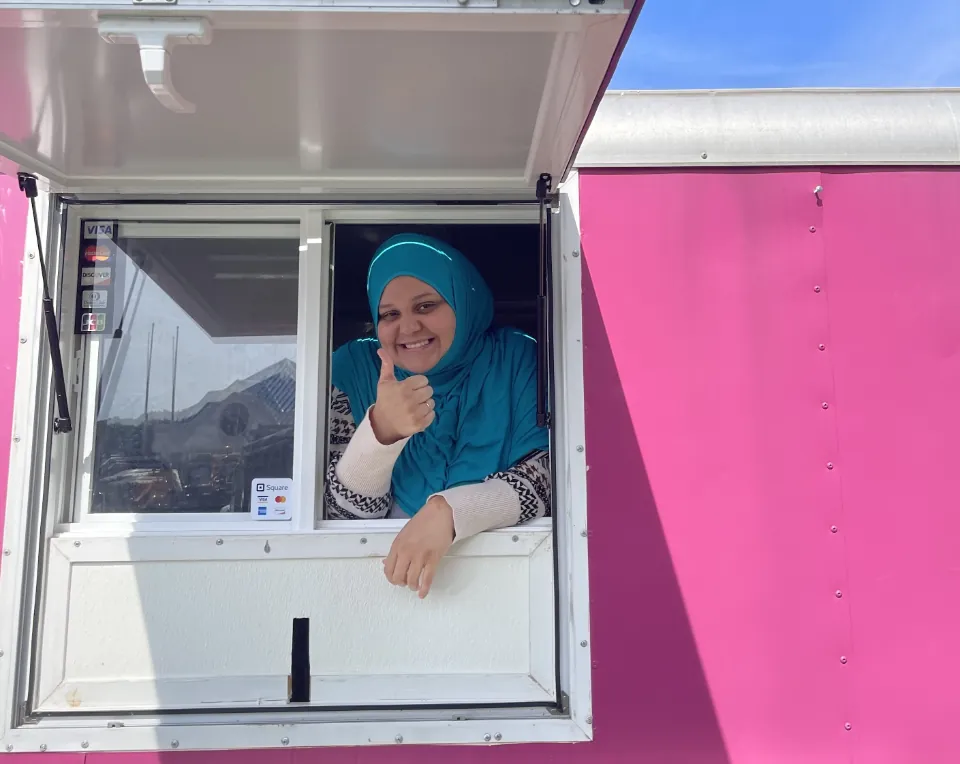
A few months ago, my husband gave me the idea of opening a food truck. My husband is from Africa and we both know how to cook a variety of different African food dishes. At first, I was a little hesitant because I had never imagined having a food truck business, but after carefully analyzing the idea, I agreed! I figured, we both know how to cook amazing authentic African food, we both love cooking, it’s an amazing opportunity to connect with our local community and I studied business; so, it’s a win-win!
I have obtained a food manager license through ANSI an accredited company and we are working to get all the safety, permits and licenses required to operate our food truck. We recently secured our food trailer and are diligently working on a few more things to get off the ground and become operational. We are committed to helping ourselves obtain everything needed to be successful in this business world while trying to move forward through this process.
A Kiva Loan provides a perfect solution for us as our Islamic religious beliefs forbids paying interest rates. This loan will connect us to our community and allow us to open our business to serve the community as well. Another win-win!
 Adding to basket
Funded
Destiny
Adam's Halal African Food

Repayment schedule
Monthly: One repayment made per month
End of term: One repayment made at the end of the loan term
Irregular: Any other repayment schedule
To see a detailed repayment schedule for a specific loan, click the "Repayment schedule" link on the loan profile under "Loan details."
What is the disbursed date?
In the case of partner loans, many of our Lending Partners choose to disburse loan funds before the loan request is posted on Kiva. We allow pre-disbursal because it ensures that the funds reach the borrower as soon as they are needed. Loan funds from Kiva lenders then go to backfill that amount and as a lender you assume the risk of the loan. By doing this, our Lending Partners assume the risk that, if the loan isn't funded by lenders, they will have to fund the loan without any funds from Kiva.
If a partner loan is not pre-disbursed, it will be listed on Kiva with an expected "post-disbursed" date. If a post-disbursed loan is not funded on Kiva, there is a chance that the borrower may not receive their loan. Some Lending Partners choose to disburse loans with other sources of funding, while other partners don't have the resources available to fund loans without Kiva lenders' support. No direct loans will be disbursed unless they fully fundraise on Kiva.
Funding model
What does "Partner covers currency loss" mean & how could it affect my Kiva loans?
Potential for currency exchange loss is noted on every loan profile under the loan details:
"Yes" means the Lending Partner will cover any currency loss. Lenders will not bear losses due to currency fluctuation
"Partial" means that the Lending Partner has opted to cover losses only up to 10%. If the U.S. dollar appreciates more than 10% against the local currency, those losses will be passed onto lenders.
"No" means that the Lending Partner is not covering any currency losses and all losses will be passed onto lenders.
"N/A" means the Lending Partner disburses loans to borrowers in USD so their loans are not subject to any currency fluctuation.
Do Kiva borrowers pay any interest on their loans?
Our partners collect interest from borrowers because there are many operational expenses associated with microfinance in developing markets, especially in rural areas. Many of Kiva's Lending Partners also provide additional services alongside their loan products such as business training, financial literacy lessons, or health services.
Kiva will not partner with an organization that charges unreasonable interest rates, and we require Lending Partners to fully disclose their rates. In addition, we only partner with microfinance institutions and organizations that have a social mission to serve the poor, unbanked, and underserved.
There are some 0% interest loans on Kiva, including all direct loans in the United States. To learn more about the interest rates Kiva borrowers pay, you can review the "Average cost to borrower" field on a loan profile.
We also encourage you to read the following articles if you are interested in further educating yourself on the topic: Microfinance 101 (https://www.kiva.org/microfinance), Top 10 things to know about microfinance (https://www.kiva.org/blog/top-10-things-to-know-about-microfinance), Microfinance interest rates explained (https://www.kiva.org/blog/whats-up-with-microfinance-interest-rates)
What is a risk rating?
The Lending Partner risk rating reflects the risk of institutional default associated with each of Kiva’s Lending Partners. A 0.5-star rating means the organization has a relatively higher risk of institutional default, while a 5-star rating indicates the organization is at a relatively lower risk of default, based on Kiva's analysis and the available information displayed in the Lending Partner section of every loan. Lending Partners with the lowest credit tier undergo a lighter level of due diligence and do not receive a risk rating; instead, in places where a risk rating would normally appear, these partners are labeled as “Experimental.” For more information, see "What is an Experimental Lending Partner?"
Direct loans also do not receive a formal risk rating. Instead, these loans are approved through “social underwriting”, where trustworthiness is determined by friends & family lending a portion of the loan request, or by a Kiva approved Trustee vouching for the borrower. Direct loans will appear as "Unrated" and lenders should always assume these loans represent the highest level of repayment risk on Kiva.
How are loans facilitated?
Kiva loans are facilitated through 2 models, partner and direct, that enable us to reach the greatest number of people around the world.
For partner loans, borrowers apply to a local Lending Partner, which manages the loan on the ground. Lending Partners are responsible for screening borrowers, disbursing loans, posting borrowers to the Kiva website for funding, collecting repayments and otherwise administering Kiva loans on the ground to borrowers.
For direct loans, borrowers apply through the Kiva website and may or may not be endorsed by a Trustee. Unlike Lending Partners, Trustees don't handle any financial transactions or have any duty to repay loans on behalf of their borrowers. Instead, Trustees take the role of providing support and business advice to their borrowers throughout the term of the loan.
More information about successive and concurrent loans
Most borrowers take out loans consecutively, meaning that they receive a second loan after having repaid the first. However, sometimes our Lending Partners give out concurrent loans, allowing borrowers to take out one primary loan and a secondary "add-on" loan along with it. These additional loans are typically smaller than the borrower's primary loan and serve a different purpose. We trust our partners to determine whether a borrower has the means to be able to repay a successive or concurrent loan.
A loan helped a Muslim-owned small business launch and serve the community delicious African Food.
Destiny's story
This loan is special because:
More about this loan
Business Description
Our business, Adam’s Halal African Food will operate in Milwaukee, WI and it fits us perfectly! I am the one that came up with the name. My husband’s last name is Adam and our food will be 100% halal and African! Halal means that the meat is slaughtered according to the Islamic beliefs, and no pork or alcohol ingredients are present.
We plan to have five main amazing dishes. One is called ziggney; which is a spicy lamb stew that has a burst of flavors that will melt in your mouth. The second one is a savory eggplant salad that is fried golden and mixed together in a hot pot of veggies which has an amazing taste, you have to experience for yourself! The third one is slow roasted lamb that falls off the bone with a hint of garlic served with customers choice of bread or rice. The fourth one includes the slow roasted lamb, with potatoes and a vegetable stew served with bread to help warm you up on cold winter nights. Last but not least, the number one star of the show, a very time consuming, delightful, respected dish, is a delicious okra powder that originated from Sudan (Sudanese style) mixed with ground beef, a staple in Sudanese culture, which will make many, if not all, Sudanese, Eritrean and Ethiopian customers come running for a taste of home!
My husband and I now have the food truck but we need a few more things to get off the ground and open for business. We are currently looking for a service base and once that is found, we can send in the applications and get the process started to obtain the licenses.
What is the purpose of this loan?
A Kiva loan will help us to make our dreams come true, With the loan we will be able to pay for the required licenses needed to operate, buy the equipment needed to run, prepare and store food in our food trailer, and pay for the rent for two months for a service base for our business.
This loan will help us to be successful securing the final elements to start our business so we can begin serving the community our delicious African food.
Specifically, Kiva loan funds will be allocated as follows:
- First two months of rent for service base (about 34% of loan funds);
- Generator (about 37% of loan funds);
- License fees (about 20% of loan funds);
- Parking fees for the food truck (about 9% of loan funds)
Loan details
Loan length:
Repayment schedule
Monthly: One repayment made per month
End of term: One repayment made at the end of the loan term
Irregular: Any other repayment schedule
To see a detailed repayment schedule for a specific loan, click the "Repayment schedule" link on the loan profile under "Loan details."
What is the disbursed date?
In the case of partner loans, many of our Lending Partners choose to disburse loan funds before the loan request is posted on Kiva. We allow pre-disbursal because it ensures that the funds reach the borrower as soon as they are needed. Loan funds from Kiva lenders then go to backfill that amount and as a lender you assume the risk of the loan. By doing this, our Lending Partners assume the risk that, if the loan isn't funded by lenders, they will have to fund the loan without any funds from Kiva.
If a partner loan is not pre-disbursed, it will be listed on Kiva with an expected "post-disbursed" date. If a post-disbursed loan is not funded on Kiva, there is a chance that the borrower may not receive their loan. Some Lending Partners choose to disburse loans with other sources of funding, while other partners don't have the resources available to fund loans without Kiva lenders' support. No direct loans will be disbursed unless they fully fundraise on Kiva.
Funding model
What does "Partner covers currency loss" mean & how could it affect my Kiva loans?
Potential for currency exchange loss is noted on every loan profile under the loan details:
"Yes" means the Lending Partner will cover any currency loss. Lenders will not bear losses due to currency fluctuation
"Partial" means that the Lending Partner has opted to cover losses only up to 10%. If the U.S. dollar appreciates more than 10% against the local currency, those losses will be passed onto lenders.
"No" means that the Lending Partner is not covering any currency losses and all losses will be passed onto lenders.
"N/A" means the Lending Partner disburses loans to borrowers in USD so their loans are not subject to any currency fluctuation.
Do Kiva borrowers pay any interest on their loans?
Our partners collect interest from borrowers because there are many operational expenses associated with microfinance in developing markets, especially in rural areas. Many of Kiva's Lending Partners also provide additional services alongside their loan products such as business training, financial literacy lessons, or health services.
Kiva will not partner with an organization that charges unreasonable interest rates, and we require Lending Partners to fully disclose their rates. In addition, we only partner with microfinance institutions and organizations that have a social mission to serve the poor, unbanked, and underserved.
There are some 0% interest loans on Kiva, including all direct loans in the United States. To learn more about the interest rates Kiva borrowers pay, you can review the "Average cost to borrower" field on a loan profile.
We also encourage you to read the following articles if you are interested in further educating yourself on the topic: Microfinance 101 (https://www.kiva.org/microfinance), Top 10 things to know about microfinance (https://www.kiva.org/blog/top-10-things-to-know-about-microfinance), Microfinance interest rates explained (https://www.kiva.org/blog/whats-up-with-microfinance-interest-rates)
What is a risk rating?
The Lending Partner risk rating reflects the risk of institutional default associated with each of Kiva’s Lending Partners. A 0.5-star rating means the organization has a relatively higher risk of institutional default, while a 5-star rating indicates the organization is at a relatively lower risk of default, based on Kiva's analysis and the available information displayed in the Lending Partner section of every loan. Lending Partners with the lowest credit tier undergo a lighter level of due diligence and do not receive a risk rating; instead, in places where a risk rating would normally appear, these partners are labeled as “Experimental.” For more information, see "What is an Experimental Lending Partner?"
Direct loans also do not receive a formal risk rating. Instead, these loans are approved through “social underwriting”, where trustworthiness is determined by friends & family lending a portion of the loan request, or by a Kiva approved Trustee vouching for the borrower. Direct loans will appear as "Unrated" and lenders should always assume these loans represent the highest level of repayment risk on Kiva.
How are loans facilitated?
Kiva loans are facilitated through 2 models, partner and direct, that enable us to reach the greatest number of people around the world.
For partner loans, borrowers apply to a local Lending Partner, which manages the loan on the ground. Lending Partners are responsible for screening borrowers, disbursing loans, posting borrowers to the Kiva website for funding, collecting repayments and otherwise administering Kiva loans on the ground to borrowers.
For direct loans, borrowers apply through the Kiva website and may or may not be endorsed by a Trustee. Unlike Lending Partners, Trustees don't handle any financial transactions or have any duty to repay loans on behalf of their borrowers. Instead, Trustees take the role of providing support and business advice to their borrowers throughout the term of the loan.
More information about successive and concurrent loans
Most borrowers take out loans consecutively, meaning that they receive a second loan after having repaid the first. However, sometimes our Lending Partners give out concurrent loans, allowing borrowers to take out one primary loan and a secondary "add-on" loan along with it. These additional loans are typically smaller than the borrower's primary loan and serve a different purpose. We trust our partners to determine whether a borrower has the means to be able to repay a successive or concurrent loan.
About Adam's Halal African Food
Industry: Food
Years in operation: 6 months - 1 year
Lenders and lending teams
Country: United States
Trustee

What are Trustee tiers?
For for more information about Trustee tiers, visit: kivaushub.org/trustee-tiers
Tags
Loan tags help lenders find loans that match certain areas of interest.
Loan details
Loan length:
Repayment schedule
Monthly: One repayment made per month
End of term: One repayment made at the end of the loan term
Irregular: Any other repayment schedule
To see a detailed repayment schedule for a specific loan, click the "Repayment schedule" link on the loan profile under "Loan details."
What is the disbursed date?
In the case of partner loans, many of our Lending Partners choose to disburse loan funds before the loan request is posted on Kiva. We allow pre-disbursal because it ensures that the funds reach the borrower as soon as they are needed. Loan funds from Kiva lenders then go to backfill that amount and as a lender you assume the risk of the loan. By doing this, our Lending Partners assume the risk that, if the loan isn't funded by lenders, they will have to fund the loan without any funds from Kiva.
If a partner loan is not pre-disbursed, it will be listed on Kiva with an expected "post-disbursed" date. If a post-disbursed loan is not funded on Kiva, there is a chance that the borrower may not receive their loan. Some Lending Partners choose to disburse loans with other sources of funding, while other partners don't have the resources available to fund loans without Kiva lenders' support. No direct loans will be disbursed unless they fully fundraise on Kiva.
Funding model
What does "Partner covers currency loss" mean & how could it affect my Kiva loans?
Potential for currency exchange loss is noted on every loan profile under the loan details:
"Yes" means the Lending Partner will cover any currency loss. Lenders will not bear losses due to currency fluctuation
"Partial" means that the Lending Partner has opted to cover losses only up to 10%. If the U.S. dollar appreciates more than 10% against the local currency, those losses will be passed onto lenders.
"No" means that the Lending Partner is not covering any currency losses and all losses will be passed onto lenders.
"N/A" means the Lending Partner disburses loans to borrowers in USD so their loans are not subject to any currency fluctuation.
Do Kiva borrowers pay any interest on their loans?
Our partners collect interest from borrowers because there are many operational expenses associated with microfinance in developing markets, especially in rural areas. Many of Kiva's Lending Partners also provide additional services alongside their loan products such as business training, financial literacy lessons, or health services.
Kiva will not partner with an organization that charges unreasonable interest rates, and we require Lending Partners to fully disclose their rates. In addition, we only partner with microfinance institutions and organizations that have a social mission to serve the poor, unbanked, and underserved.
There are some 0% interest loans on Kiva, including all direct loans in the United States. To learn more about the interest rates Kiva borrowers pay, you can review the "Average cost to borrower" field on a loan profile.
We also encourage you to read the following articles if you are interested in further educating yourself on the topic: Microfinance 101 (https://www.kiva.org/microfinance), Top 10 things to know about microfinance (https://www.kiva.org/blog/top-10-things-to-know-about-microfinance), Microfinance interest rates explained (https://www.kiva.org/blog/whats-up-with-microfinance-interest-rates)
What is a risk rating?
The Lending Partner risk rating reflects the risk of institutional default associated with each of Kiva’s Lending Partners. A 0.5-star rating means the organization has a relatively higher risk of institutional default, while a 5-star rating indicates the organization is at a relatively lower risk of default, based on Kiva's analysis and the available information displayed in the Lending Partner section of every loan. Lending Partners with the lowest credit tier undergo a lighter level of due diligence and do not receive a risk rating; instead, in places where a risk rating would normally appear, these partners are labeled as “Experimental.” For more information, see "What is an Experimental Lending Partner?"
Direct loans also do not receive a formal risk rating. Instead, these loans are approved through “social underwriting”, where trustworthiness is determined by friends & family lending a portion of the loan request, or by a Kiva approved Trustee vouching for the borrower. Direct loans will appear as "Unrated" and lenders should always assume these loans represent the highest level of repayment risk on Kiva.
How are loans facilitated?
Kiva loans are facilitated through 2 models, partner and direct, that enable us to reach the greatest number of people around the world.
For partner loans, borrowers apply to a local Lending Partner, which manages the loan on the ground. Lending Partners are responsible for screening borrowers, disbursing loans, posting borrowers to the Kiva website for funding, collecting repayments and otherwise administering Kiva loans on the ground to borrowers.
For direct loans, borrowers apply through the Kiva website and may or may not be endorsed by a Trustee. Unlike Lending Partners, Trustees don't handle any financial transactions or have any duty to repay loans on behalf of their borrowers. Instead, Trustees take the role of providing support and business advice to their borrowers throughout the term of the loan.
More information about successive and concurrent loans
Most borrowers take out loans consecutively, meaning that they receive a second loan after having repaid the first. However, sometimes our Lending Partners give out concurrent loans, allowing borrowers to take out one primary loan and a secondary "add-on" loan along with it. These additional loans are typically smaller than the borrower's primary loan and serve a different purpose. We trust our partners to determine whether a borrower has the means to be able to repay a successive or concurrent loan.
Trustee
What are Trustee tiers?
For for more information about Trustee tiers, visit: kivaushub.org/trustee-tiers
You are opting out of using Free Trial.
You have selected to not use your Free Trial and will be prompted to pay for this loan using your own money.
Agree Use a Free TrialShoot! This loan is ineligible.
Your free credit can't be applied to this loan. If you would like to make a loan to this borrower anyway, you will have to use your own money.
Lend Anyway Find an Eligible LoanYou cannot use your Free Trial to support this loan.
Free Trials cannot be used to make loans during their private fundraising period on Kiva. If you would like to lend to this borrower anyway, you will have to use your own money.
Agree Find an Eligible Loan