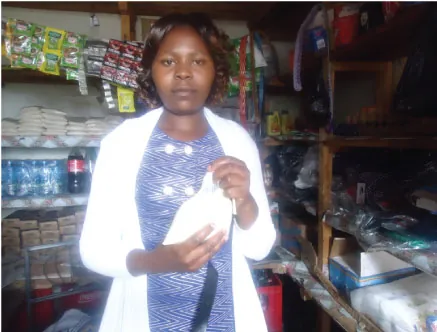
I was born in Igoji area of Meru, Eastern Kenya in 1988 to farmer parents. My home district is famous for Kaat cultivation locally known as Miraa farming. Usually this fetches a lot of profit for farmers making the region economically stable. Unfortunately, my parents were both ailing when I was growing up making them unfit for any form of farm work. They were also forced to sell our land in order to afford medical treatment. This is the reason we moved closer to Nairobi city, so that they could make regular trips to hospital. As a first born of 4, I took on many responsibilities at home. This caused me to later perform poorly in school and miss out on tertiary education which is required for white collar jobs in Kenya. My lack of skills training made it difficult to earn money to help support my siblings. Later, I learnt about CAP Youth Empowerment Institute which was starting a training center in Athi River for youth like me. I attended their Roadshows and was later selected to join the Industrial Garment Manufacturing class. While at CAP, I developed a special interest in entrepreneurship which was a cross cutting course for all trainees. Because I had often tried my hand at various small businesses to help my parents, e.g, selling bananas and mangoes, I knew that small business was good for making money. Through financial literacy training offered at CAP, I learnt to save money as I became more involved in small businesses. At that time, I began to ferry clean water to families in the community for which they would pay Ksh. 20 for a 10 liter jerrycan. This boosted my savings. Later, an uncle lent me Ksh. 30,000 which combined with my personal savings, enabled me start my retail shop. Today, the shop has grown from a mere kiosk retailing fewer than 20 items to a well stocked shop with more than 50 items on sale like sugar, flour, bread, soap and candy. I can now help to pay for my younger siblings school fees as well as support myself. My parents still struggle with ill-health but I am able to buy them healthy foods like fruits and legumes to help them too.
 Adding to basket
Funded
Doreen
Kinanu Retail Shop

Repayment schedule
Monthly: One repayment made per month
End of term: One repayment made at the end of the loan term
Irregular: Any other repayment schedule
To see a detailed repayment schedule for a specific loan, click the "Repayment schedule" link on the loan profile under "Loan details."
What is the disbursed date?
In the case of partner loans, many of our Lending Partners choose to disburse loan funds before the loan request is posted on Kiva. We allow pre-disbursal because it ensures that the funds reach the borrower as soon as they are needed. Loan funds from Kiva lenders then go to backfill that amount and as a lender you assume the risk of the loan. By doing this, our Lending Partners assume the risk that, if the loan isn't funded by lenders, they will have to fund the loan without any funds from Kiva.
If a partner loan is not pre-disbursed, it will be listed on Kiva with an expected "post-disbursed" date. If a post-disbursed loan is not funded on Kiva, there is a chance that the borrower may not receive their loan. Some Lending Partners choose to disburse loans with other sources of funding, while other partners don't have the resources available to fund loans without Kiva lenders' support. No direct loans will be disbursed unless they fully fundraise on Kiva.
Funding model
What does "Partner covers currency loss" mean & how could it affect my Kiva loans?
Potential for currency exchange loss is noted on every loan profile under the loan details:
"Yes" means the Lending Partner will cover any currency loss. Lenders will not bear losses due to currency fluctuation
"Partial" means that the Lending Partner has opted to cover losses only up to 10%. If the U.S. dollar appreciates more than 10% against the local currency, those losses will be passed onto lenders.
"No" means that the Lending Partner is not covering any currency losses and all losses will be passed onto lenders.
"N/A" means the Lending Partner disburses loans to borrowers in USD so their loans are not subject to any currency fluctuation.
Do Kiva borrowers pay any interest on their loans?
Our partners collect interest from borrowers because there are many operational expenses associated with microfinance in developing markets, especially in rural areas. Many of Kiva's Lending Partners also provide additional services alongside their loan products such as business training, financial literacy lessons, or health services.
Kiva will not partner with an organization that charges unreasonable interest rates, and we require Lending Partners to fully disclose their rates. In addition, we only partner with microfinance institutions and organizations that have a social mission to serve the poor, unbanked, and underserved.
There are some 0% interest loans on Kiva, including all direct loans in the United States. To learn more about the interest rates Kiva borrowers pay, you can review the "Average cost to borrower" field on a loan profile.
We also encourage you to read the following articles if you are interested in further educating yourself on the topic: Microfinance 101 (https://www.kiva.org/microfinance), Top 10 things to know about microfinance (https://www.kiva.org/blog/top-10-things-to-know-about-microfinance), Microfinance interest rates explained (https://www.kiva.org/blog/whats-up-with-microfinance-interest-rates)
What is a risk rating?
The Lending Partner risk rating reflects the risk of institutional default associated with each of Kiva’s Lending Partners. A 0.5-star rating means the organization has a relatively higher risk of institutional default, while a 5-star rating indicates the organization is at a relatively lower risk of default, based on Kiva's analysis and the available information displayed in the Lending Partner section of every loan. Lending Partners with the lowest credit tier undergo a lighter level of due diligence and do not receive a risk rating; instead, in places where a risk rating would normally appear, these partners are labeled as “Experimental.” For more information, see "What is an Experimental Lending Partner?"
Direct loans also do not receive a formal risk rating. Instead, these loans are approved through “social underwriting”, where trustworthiness is determined by friends & family lending a portion of the loan request, or by a Kiva approved Trustee vouching for the borrower. Direct loans will appear as "Unrated" and lenders should always assume these loans represent the highest level of repayment risk on Kiva.
How are loans facilitated?
Kiva loans are facilitated through 2 models, partner and direct, that enable us to reach the greatest number of people around the world.
For partner loans, borrowers apply to a local Lending Partner, which manages the loan on the ground. Lending Partners are responsible for screening borrowers, disbursing loans, posting borrowers to the Kiva website for funding, collecting repayments and otherwise administering Kiva loans on the ground to borrowers.
For direct loans, borrowers apply through the Kiva website and may or may not be endorsed by a Trustee. Unlike Lending Partners, Trustees don't handle any financial transactions or have any duty to repay loans on behalf of their borrowers. Instead, Trustees take the role of providing support and business advice to their borrowers throughout the term of the loan.
More information about successive and concurrent loans
Most borrowers take out loans consecutively, meaning that they receive a second loan after having repaid the first. However, sometimes our Lending Partners give out concurrent loans, allowing borrowers to take out one primary loan and a secondary "add-on" loan along with it. These additional loans are typically smaller than the borrower's primary loan and serve a different purpose. We trust our partners to determine whether a borrower has the means to be able to repay a successive or concurrent loan.
A loan helped buy ladies and men's shoes to sell in my shop.
Doreen's story
More about this loan
Business Description
My business can be described as a general retail shop because I sell a number of household items at retail price. I decided to start this business in mid 2012 after undergoing entrepreneurship training at CAP Youth Empowerment Institute in Athi River. In the past, I had done small business selling bananas and other assorted goods usually by the roadside or as a hawker to help support my family. This experience had taught me that small business can be a good source of income. When, after CAP training, and while practicing another small enterprise vending water, my uncle lent me some capital, I decided that a retail shop would be a stable business venture for me. This is because I wanted a permanent location near home so that I could look after my parents and siblings. The business has grown steadily but my biggest challenge has been lack of sufficient investment capital to really revolutionize my small retail shop into a wholesale and also a family cloths shop. The market is ripe for this because many people have to travel to the next town to get a variety of clothing and other goods. My customers are mainly the working class who pass through my location on the way to and from work in the big factories around Athi River. I hope to save enough and access business loans to grow my business into a larger store with a variety of family goods. In the short term, I hope to add second hand cloths to my stock so that my customers don't have to travel to other locations for good and affordable clothing. Today, I'm so proud of the fact that my small business has been able to gain popularity because of my friendly nature and good rapport with customers.
What is the purpose of this loan?
I want to add stock of 10 pairs of ladies shoes costing K sh. 800 each, totaling K sh. 8000, 8 pairs of men's shoes costing K sh. 1700 each, totaling K sh 13600. This purchase will increase my revenue because there is a ready market for the commodity which has a high profit margin of approximately K sh. 500 per pair of shoes sold. This loan of K sh. 20000 will impact my business by expanding my stock and increasing my customer base thereby improving my profits. The loan will impact my life by enabling me improve my savings which I will eventually use to purchase land and build a home for my family.
Loan details
Loan length:
Repayment schedule
Monthly: One repayment made per month
End of term: One repayment made at the end of the loan term
Irregular: Any other repayment schedule
To see a detailed repayment schedule for a specific loan, click the "Repayment schedule" link on the loan profile under "Loan details."
What is the disbursed date?
In the case of partner loans, many of our Lending Partners choose to disburse loan funds before the loan request is posted on Kiva. We allow pre-disbursal because it ensures that the funds reach the borrower as soon as they are needed. Loan funds from Kiva lenders then go to backfill that amount and as a lender you assume the risk of the loan. By doing this, our Lending Partners assume the risk that, if the loan isn't funded by lenders, they will have to fund the loan without any funds from Kiva.
If a partner loan is not pre-disbursed, it will be listed on Kiva with an expected "post-disbursed" date. If a post-disbursed loan is not funded on Kiva, there is a chance that the borrower may not receive their loan. Some Lending Partners choose to disburse loans with other sources of funding, while other partners don't have the resources available to fund loans without Kiva lenders' support. No direct loans will be disbursed unless they fully fundraise on Kiva.
Funding model
What does "Partner covers currency loss" mean & how could it affect my Kiva loans?
Potential for currency exchange loss is noted on every loan profile under the loan details:
"Yes" means the Lending Partner will cover any currency loss. Lenders will not bear losses due to currency fluctuation
"Partial" means that the Lending Partner has opted to cover losses only up to 10%. If the U.S. dollar appreciates more than 10% against the local currency, those losses will be passed onto lenders.
"No" means that the Lending Partner is not covering any currency losses and all losses will be passed onto lenders.
"N/A" means the Lending Partner disburses loans to borrowers in USD so their loans are not subject to any currency fluctuation.
Do Kiva borrowers pay any interest on their loans?
Our partners collect interest from borrowers because there are many operational expenses associated with microfinance in developing markets, especially in rural areas. Many of Kiva's Lending Partners also provide additional services alongside their loan products such as business training, financial literacy lessons, or health services.
Kiva will not partner with an organization that charges unreasonable interest rates, and we require Lending Partners to fully disclose their rates. In addition, we only partner with microfinance institutions and organizations that have a social mission to serve the poor, unbanked, and underserved.
There are some 0% interest loans on Kiva, including all direct loans in the United States. To learn more about the interest rates Kiva borrowers pay, you can review the "Average cost to borrower" field on a loan profile.
We also encourage you to read the following articles if you are interested in further educating yourself on the topic: Microfinance 101 (https://www.kiva.org/microfinance), Top 10 things to know about microfinance (https://www.kiva.org/blog/top-10-things-to-know-about-microfinance), Microfinance interest rates explained (https://www.kiva.org/blog/whats-up-with-microfinance-interest-rates)
What is a risk rating?
The Lending Partner risk rating reflects the risk of institutional default associated with each of Kiva’s Lending Partners. A 0.5-star rating means the organization has a relatively higher risk of institutional default, while a 5-star rating indicates the organization is at a relatively lower risk of default, based on Kiva's analysis and the available information displayed in the Lending Partner section of every loan. Lending Partners with the lowest credit tier undergo a lighter level of due diligence and do not receive a risk rating; instead, in places where a risk rating would normally appear, these partners are labeled as “Experimental.” For more information, see "What is an Experimental Lending Partner?"
Direct loans also do not receive a formal risk rating. Instead, these loans are approved through “social underwriting”, where trustworthiness is determined by friends & family lending a portion of the loan request, or by a Kiva approved Trustee vouching for the borrower. Direct loans will appear as "Unrated" and lenders should always assume these loans represent the highest level of repayment risk on Kiva.
How are loans facilitated?
Kiva loans are facilitated through 2 models, partner and direct, that enable us to reach the greatest number of people around the world.
For partner loans, borrowers apply to a local Lending Partner, which manages the loan on the ground. Lending Partners are responsible for screening borrowers, disbursing loans, posting borrowers to the Kiva website for funding, collecting repayments and otherwise administering Kiva loans on the ground to borrowers.
For direct loans, borrowers apply through the Kiva website and may or may not be endorsed by a Trustee. Unlike Lending Partners, Trustees don't handle any financial transactions or have any duty to repay loans on behalf of their borrowers. Instead, Trustees take the role of providing support and business advice to their borrowers throughout the term of the loan.
More information about successive and concurrent loans
Most borrowers take out loans consecutively, meaning that they receive a second loan after having repaid the first. However, sometimes our Lending Partners give out concurrent loans, allowing borrowers to take out one primary loan and a secondary "add-on" loan along with it. These additional loans are typically smaller than the borrower's primary loan and serve a different purpose. We trust our partners to determine whether a borrower has the means to be able to repay a successive or concurrent loan.
About Kinanu Retail Shop
Industry: Retail
Years in operation: 1 year - 3 years
Lenders and lending teams
Country: Kenya
Trustee: CAP Youth Empowerment Institute

What are Trustee tiers?
For for more information about Trustee tiers, visit: kivaushub.org/trustee-tiers
Why are you endorsing Doreen?
We are recommending Doreen for another loan because she has demonstrated discipline in repayment and has used the loan wisely to expand her business. We believe that a repeat loan will enable her to earn more money from her business, help her family more and develop herself as an entrepreneur.
Loan details
Loan length:
Repayment schedule
Monthly: One repayment made per month
End of term: One repayment made at the end of the loan term
Irregular: Any other repayment schedule
To see a detailed repayment schedule for a specific loan, click the "Repayment schedule" link on the loan profile under "Loan details."
What is the disbursed date?
In the case of partner loans, many of our Lending Partners choose to disburse loan funds before the loan request is posted on Kiva. We allow pre-disbursal because it ensures that the funds reach the borrower as soon as they are needed. Loan funds from Kiva lenders then go to backfill that amount and as a lender you assume the risk of the loan. By doing this, our Lending Partners assume the risk that, if the loan isn't funded by lenders, they will have to fund the loan without any funds from Kiva.
If a partner loan is not pre-disbursed, it will be listed on Kiva with an expected "post-disbursed" date. If a post-disbursed loan is not funded on Kiva, there is a chance that the borrower may not receive their loan. Some Lending Partners choose to disburse loans with other sources of funding, while other partners don't have the resources available to fund loans without Kiva lenders' support. No direct loans will be disbursed unless they fully fundraise on Kiva.
Funding model
What does "Partner covers currency loss" mean & how could it affect my Kiva loans?
Potential for currency exchange loss is noted on every loan profile under the loan details:
"Yes" means the Lending Partner will cover any currency loss. Lenders will not bear losses due to currency fluctuation
"Partial" means that the Lending Partner has opted to cover losses only up to 10%. If the U.S. dollar appreciates more than 10% against the local currency, those losses will be passed onto lenders.
"No" means that the Lending Partner is not covering any currency losses and all losses will be passed onto lenders.
"N/A" means the Lending Partner disburses loans to borrowers in USD so their loans are not subject to any currency fluctuation.
Do Kiva borrowers pay any interest on their loans?
Our partners collect interest from borrowers because there are many operational expenses associated with microfinance in developing markets, especially in rural areas. Many of Kiva's Lending Partners also provide additional services alongside their loan products such as business training, financial literacy lessons, or health services.
Kiva will not partner with an organization that charges unreasonable interest rates, and we require Lending Partners to fully disclose their rates. In addition, we only partner with microfinance institutions and organizations that have a social mission to serve the poor, unbanked, and underserved.
There are some 0% interest loans on Kiva, including all direct loans in the United States. To learn more about the interest rates Kiva borrowers pay, you can review the "Average cost to borrower" field on a loan profile.
We also encourage you to read the following articles if you are interested in further educating yourself on the topic: Microfinance 101 (https://www.kiva.org/microfinance), Top 10 things to know about microfinance (https://www.kiva.org/blog/top-10-things-to-know-about-microfinance), Microfinance interest rates explained (https://www.kiva.org/blog/whats-up-with-microfinance-interest-rates)
What is a risk rating?
The Lending Partner risk rating reflects the risk of institutional default associated with each of Kiva’s Lending Partners. A 0.5-star rating means the organization has a relatively higher risk of institutional default, while a 5-star rating indicates the organization is at a relatively lower risk of default, based on Kiva's analysis and the available information displayed in the Lending Partner section of every loan. Lending Partners with the lowest credit tier undergo a lighter level of due diligence and do not receive a risk rating; instead, in places where a risk rating would normally appear, these partners are labeled as “Experimental.” For more information, see "What is an Experimental Lending Partner?"
Direct loans also do not receive a formal risk rating. Instead, these loans are approved through “social underwriting”, where trustworthiness is determined by friends & family lending a portion of the loan request, or by a Kiva approved Trustee vouching for the borrower. Direct loans will appear as "Unrated" and lenders should always assume these loans represent the highest level of repayment risk on Kiva.
How are loans facilitated?
Kiva loans are facilitated through 2 models, partner and direct, that enable us to reach the greatest number of people around the world.
For partner loans, borrowers apply to a local Lending Partner, which manages the loan on the ground. Lending Partners are responsible for screening borrowers, disbursing loans, posting borrowers to the Kiva website for funding, collecting repayments and otherwise administering Kiva loans on the ground to borrowers.
For direct loans, borrowers apply through the Kiva website and may or may not be endorsed by a Trustee. Unlike Lending Partners, Trustees don't handle any financial transactions or have any duty to repay loans on behalf of their borrowers. Instead, Trustees take the role of providing support and business advice to their borrowers throughout the term of the loan.
More information about successive and concurrent loans
Most borrowers take out loans consecutively, meaning that they receive a second loan after having repaid the first. However, sometimes our Lending Partners give out concurrent loans, allowing borrowers to take out one primary loan and a secondary "add-on" loan along with it. These additional loans are typically smaller than the borrower's primary loan and serve a different purpose. We trust our partners to determine whether a borrower has the means to be able to repay a successive or concurrent loan.
Trustee: CAP Youth Empowerment Institute
What are Trustee tiers?
For for more information about Trustee tiers, visit: kivaushub.org/trustee-tiers
Why are you endorsing Doreen?
We are recommending Doreen for another loan because she has demonstrated discipline in repayment and has used the loan wisely to expand her business. We believe that a repeat loan will enable her to earn more money from her business, help her family more and develop herself as an entrepreneur.
You are opting out of using Free Trial.
You have selected to not use your Free Trial and will be prompted to pay for this loan using your own money.
Agree Use a Free TrialShoot! This loan is ineligible.
Your free credit can't be applied to this loan. If you would like to make a loan to this borrower anyway, you will have to use your own money.
Lend Anyway Find an Eligible LoanYou cannot use your Free Trial to support this loan.
Free Trials cannot be used to make loans during their private fundraising period on Kiva. If you would like to lend to this borrower anyway, you will have to use your own money.
Agree Find an Eligible Loan